
Industry trends, technical guides, and case studies on storm-resilient solar streetlights.
Learn about Cat 5 hurricane resistance, bifacial panel technology, and battery reserve dynamics.

See how developers, HOAs, and municipalities achieve zero grid dependency.
Choosing outdoor lighting near beaches, dunes, or coastal gardens requires more than comparing brightness and battery life. NOAA Fisheries identifies six sea turtle species in U.S. waters, while several species depend on dark beaches for nesting and hatchling survival. Artificial light can pull hatchlings inland, away from the moonlit ocean horizon. That makes Turtle-Friendly Solar Lights an environmental decision, not merely a garden upgrade.
This guide examines seven practical choices through established conservation guidance from NOAA Fisheries, the Florida Fish and Wildlife Conservation Commission, and the Sea Turtle Conservancy. These organizations commonly emphasize shielding, low mounting, reduced brightness, limited operating hours, and longer-wavelength amber or red light. A solar panel does not make a lamp wildlife-safe by itself. The wrong fixture can still shine across a dune like a small roadside beacon.
Look for downward-facing housings, warm amber output, motion sensors, and adjustable timers. Keep fixtures away from the beach-facing edge whenever possible. Check whether the product description states its wavelength, brightness, and beam direction. Many listings do not. That gap deserves attention.
No light is perfect.
A cautious installation may still need seasonal changes, especially during nesting and hatching periods. Local wildlife agencies can provide more specific requirements for your coastline. The following seven tips connect manufacturer claims with field-based conservation principles, helping readers choose lighting that supports visibility without turning a dark shoreline into an artificial corridor.
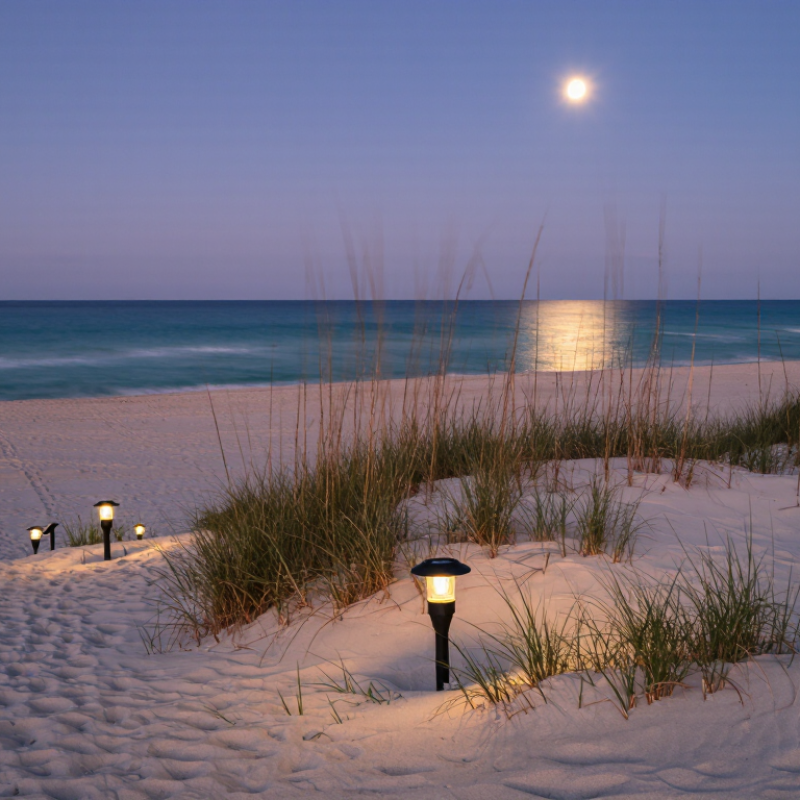
Sea turtles can mistake artificial light for moonlit water, especially after hatching. Their first crawl may turn toward a bright garden path instead of the sea. Darkness matters. Choose lights with the lowest useful brightness, and keep them far from the beach-facing side of your property. A downward shield prevents direct glare. Warm amber light is generally safer than cool white or blue-rich light, but color alone is not enough.
Use a timer to switch lights off during nesting and hatching hours. Motion sensors can reduce exposure, although sudden activation may still disturb nearby wildlife. Select steady lights without visible flicker, and place solar panels where they receive sunlight without increasing nighttime brightness. Keep fixtures low, shielded, and hidden behind walls or dense plants. Avoid reflective surfaces that bounce light toward the shoreline.
Check the property from the beach, not only from the doorway. A light that seems gentle indoors may look sharp across dark sand. Test it after sunset, then reduce its angle, height, or brightness. It is easy to assume amber means harmless. That assumption needs questioning, because intensity, distance, timing, and surrounding darkness all matter. Local wildlife officers or conservation groups may provide nesting-season guidance, and their advice should outweigh convenience. One imperfect setup can still be improved through careful observation.
Sea turtles navigate using natural light reflected from the ocean. Artificial light can draw hatchlings inland, especially near nesting beaches. The Florida Fish and Wildlife Conservation Commission’s Marine Turtle Protection Handbook recommends avoiding short wavelengths below 560 nanometers. Blue, violet, green, and ultraviolet light are especially concerning.
Choose solar lights with amber or red output. A target range of 590–620 nanometers is generally less attractive to hatchlings. The National Oceanic and Atmospheric Administration also advises using long-wavelength lighting, shielding, and the lowest practical brightness near coastal habitat. Check the technical sheet, not only the product description. “Warm white” may still contain blue wavelengths.
That label is not enough.
Look for measured spectral data, a color temperature near 2,200 kelvin or lower, and no ultraviolet emission. Fully shielded fixtures should direct light downward, away from sand and water. Motion sensors can reduce exposure, but repeated activation may still disturb nesting females. Research summarized by the U.S. Fish and Wildlife Service shows that lighting effects vary with intensity, distance, and timing. This matters because a dim lamp can remain disruptive when placed beside a nest.
I would test the light after sunset. Stand at the beach edge and check whether the lamp is visible from the sand. Packaging claims can be vague, and “red” does not guarantee a safe spectrum. When data is missing, choosing a darker area is the more responsible decision.
7 Tips for Choosing Turtle Friendly Solar Lights
Choosing Safe Brightness, Placement, and Shielding Features
Solar power does not make outdoor lighting harmless. Bright white LEDs can disturb turtles, especially near nesting beaches, ponds, and garden shelters. The Florida Fish and Wildlife Conservation Commission recommends low, shielded fixtures with long-wavelength amber or red light. Choose the lowest brightness that safely marks a path. A soft glow is usually enough.
Placement matters more than packaging claims. Keep lights away from shorelines, nesting areas, and direct sightlines across open water. Aim every beam downward. Full shielding should prevent light from escaping above the fixture’s horizontal line. Timers, motion sensors, and short operating periods reduce exposure. Avoid lights that remain active all night.
The 2016 World Atlas of Artificial Night Sky Brightness, published in Science Advances, found that over 80% of people live under light-polluted skies. More than 99% of people in the United States and Europe experience artificial skyglow. These figures explain why small lighting choices can matter. A turtle may still notice one poorly aimed lamp.
Amber color alone is not enough. Test the light from a turtle’s eye level, then check nearby sand, grass, and water. I have found that manufacturers’ brightness descriptions can feel vague. Compare actual beam spread, mounting height, and timer settings before installation. Local wildlife guidance should always influence the final choice.
| Tip | Selection Dimension | Recommended Specification | Practical Target or Check | Why It Helps Turtles |
|---|---|---|---|---|
| 1 | Choose a long-wavelength light source | Select amber, orange, or red light rather than cool-white, blue, or green light. Prefer products with a stated color temperature of 3,000 K or lower when a white-light option is unavoidable. | Look for a visible output centered toward the longer-wavelength portion of the spectrum, approximately 590–700 nm. | Short-wavelength light, especially blue and green, can interfere with sea-turtle hatchling orientation. Longer-wavelength amber and red light is generally less disruptive when lighting is necessary. |
| 2 | Use the lowest effective brightness | Avoid decorative floodlights and high-output security lamps near the beach. Choose the lowest lumen rating that safely illuminates the path, step, or entrance. | Use task-specific lighting instead of broad-area illumination; compare products by lumens and reduce the output whenever the product provides a brightness control. | Brighter light creates more visible skyglow and increases the chance that hatchlings or nesting females will be attracted away from the darker, seaward horizon. |
| 3 | Install full shielding | Select a fixture with an opaque top and side shield so the lamp is not directly visible from the beach. Use downward-directed light with no upward or seaward spill. | When viewed from the beach, the light source should be hidden behind the fixture housing or a suitable shield. | Shielding limits glare, reduces direct light reaching the shoreline, and helps preserve the dark horizon that hatchlings use for orientation. |
| 4 | Place lights landward and low | Mount lights on the landward side of structures, paths, and access points. Keep fixtures low and aim them only at the walking surface or immediate hazard. | Do not place lights on the beach, dune crest, or seaward-facing edge of a property. Keep the beam below eye level where practical. | Distance, low mounting, and landward orientation reduce the amount of artificial light visible from nesting beaches and the nearshore area. |
| 5 | Add timers, motion sensors, or manual controls | Choose solar lights with an off timer, dusk-to-dawn adjustment, motion detection, or a manual switch. Keep lighting off when people are not using the area. | Use the shortest operating period that meets safety needs and avoid continuous overnight operation during nesting and hatching seasons where local rules recommend it. | Limiting duration reduces the total amount of artificial light present during nighttime nesting and hatchling emergence. |
| 6 | Prevent glare and reflective spill | Avoid polished surfaces, clear lenses, exposed bulbs, and glossy signs that reflect light toward the shore. Use a matte, dark-colored shield where suitable. | Inspect the installation from the beach at night and remove any visible glare, reflected hotspot, or direct beam crossing the shoreline. | Reflected or scattered light can still brighten the beach even when the lamp is not pointed directly toward the water. |
| 7 | Check local wildlife requirements before installation | Confirm the lighting rules issued by the relevant coastal authority, wildlife agency, municipality, or protected-area manager. Follow stricter local requirements when they apply. | Verify permitted colors, fixture types, mounting locations, operating hours, and seasonal restrictions before purchasing or installing the light. | Turtle-lighting requirements vary by coastline, protected status, nesting season, and local conservation plan. Legal compliance is essential in addition to product selection. |
7 Tips for Choosing Turtle Friendly Solar Lights
Comparing Solar Light Controls, Sensors, and Battery Performance
Choose fixtures with warm amber or red light, and keep brightness modest. Shorter wavelengths can distract hatchlings near nesting beaches. Full shielding also prevents light from spilling across sand and water. Aim each fixture toward paths, never toward the shoreline.
A reliable timer is often better than continuous lighting. Set lights to turn off during nesting and hatching hours when possible. Motion sensors can reduce exposure, but select models with short activation periods. Test their sensitivity with a slow hand movement. Some sensors react to waves, leaves, or small animals. That can create unnecessary flashes.
Check battery capacity after three cloudy days, not just after a sunny afternoon. Lithium batteries often perform well, but cold temperatures can reduce runtime. Look for replaceable cells and clear charging indicators. A small solar panel may struggle under salt spray or nearby vegetation. Clean it regularly with fresh water. Field checks sometimes reveal an uncomfortable truth: “eco-friendly” lighting still harms wildlife when controls are poorly adjusted. I would also inspect the area at night, from the beach, because a fixture can seem dim beside it yet bright from a turtle’s viewpoint. Use local wildlife guidance when available, and record seasonal changes before changing the settings.
Checking Materials, Durability, and Wildlife-Safe Installation Practices
A turtle-friendly solar light starts with its materials. Choose UV-stabilized housing, sealed gaskets, and corrosion-resistant hardware. Near saltwater, 316 stainless steel or properly coated aluminum usually performs better. Check the IP rating under IEC 60529, but remember that water resistance does not prove salt-spray durability. Ask for test records, battery temperature limits, and replacement-part availability. Cheap plastic may become brittle after one harsh summer.
Light color matters. Sea turtle hatchlings can mistake bright, short-wavelength light for the ocean. Coastal wildlife guidance often favors dim, long-wavelength amber or red light, where local rules permit it.
The National Oceanic and Atmospheric Administration identifies artificial light as a serious nesting and hatchling threat.
A 2023 Science Advances study reported global nighttime brightness rising about 9.6% annually from 2012 to 2022. That trend makes restraint important. Lower brightness is better.
Install fixtures below eye level, facing downward, and away from beaches or nesting paths. Use full shields, timers, and motion sensors instead of all-night illumination. Keep solar panels clear, but hide them from direct shoreline views when possible. A light should never shine across sand.
I still inspect installations after storms; one tilted shield can undo careful planning.
No fixture is automatically turtle-safe. Local wildlife officers may recommend different colors, setbacks, or seasonal shutdowns. Check their current guidance before installation.
Amber or red light is usually less attractive to hatchlings. Choose wavelengths around 590–620 nanometers. Avoid blue, violet, green, and ultraviolet light.
No. Warm white can still contain short blue wavelengths. Check measured spectral data instead of trusting the label.
Use the lowest brightness that safely marks a path. A soft glow is usually enough. Brighter is not always better.
Keep lights away from beaches, shorelines, nesting areas, and open-water sightlines. Aim each beam downward. Never point it across sand or water.
Choose full shielding that blocks light above the fixture’s horizontal line. Check the lamp from sand level. Small gaps can create visible glare.
Yes, when adjusted carefully. Set lights to turn off during nesting and hatching hours when possible. Use short activation periods.
Test it after sunset from the beach edge or turtle’s eye level. Check nearby sand, grass, and water. If the lamp is clearly visible, reconsider its position or brightness.
Check performance after three cloudy days, not one sunny afternoon. Cold weather can reduce runtime. Clean the solar panel with fresh water, especially after salt spray.
No. Solar power changes the energy source, not the light’s ecological effect. I would question any “eco-friendly” claim without field testing.
Choose a darker area or use less lighting. Missing spectral data is a warning sign. Packaging can sound reassuring while remaining vague.
Choosing Turtle-Friendly Solar Lights requires more than selecting an energy-efficient outdoor fixture. Light color and wavelength can influence sea turtle behavior, especially near nesting beaches, so choose warmer, longer-wavelength light and avoid strong blue, white, or short-wavelength illumination. Brightness should be kept as low as practical, with fixtures aimed downward and positioned away from shorelines, nesting areas, and pathways leading toward the ocean. Shielding, narrow beams, timers, and motion sensors can further reduce unnecessary nighttime glow.
When comparing options, consider reliable controls, efficient batteries, and performance that remains consistent through cloudy weather. Durable, weather-resistant materials can extend product life and reduce waste, while secure installation helps prevent loose parts from becoming hazards for wildlife. Place lights where they cannot obstruct animals, damage vegetation, or create confusing reflections on sand and water. By combining responsible color selection, controlled brightness, thoughtful placement, dependable operation, and wildlife-safe installation, homeowners can enjoy outdoor lighting while reducing its impact on sea turtles.