Hurricane-Resistant Solar Lighting Engineering & Global Procurement Guide: Specifying Category 5 Storm-Proof Commercial Off-Grid Infrastructure
An authoritative technical evaluation for procurement managers, civil engineers, utilities, and commercial developers seeking extreme-weather-certified, zero-grid solar lighting solutions engineered to survive 160+ MPH wind loads and severe atmospheric events.
AASHTO LTS-6 Compliant Structural Design
5+ Days Autonomy Reserve
$0 Upfront Cost Financing Option Available
1. Executive Overview: The Engineering Physics of Hurricane-Resistant Solar Lighting
As coastal climate volatility intensifies globally, municipal procurement directors, civil engineering consultants, and commercial real estate developers face a growing challenge: standard street lighting infrastructure collapses during catastrophic weather events. Conventional grid-tied lighting systems suffer from widespread power grid failures, underground wiring submersion, and transformer destruction during Category 3, 4, and 5 hurricanes.
True Hurricane-Resistant Solar Lighting represents a fundamental engineering evolution. It transitions outdoor public and commercial lighting from vulnerable centralized grid dependencies to autonomous, localized micro-power units capable of withstanding extreme aerodynamic drag, high-velocity wind shears up to 180 mph (290 km/h), continuous saltwater corrosion, and multi-day post-storm cloud cover.
Structural Integrity Under Extreme Drag Dynamics
The primary point of failure in ordinary solar streetlights during severe storms is structural overload caused by inaccurate Effective Projected Area (EPA) calculations. Solar panels act as large wind sails. When mounted to standard light poles without rigorous aerodynamic dampening and finite element analysis (FEA), wind shear forces generate massive bending moments at the pole base, leading to structural fatigue, pole shearing, or foundation bolt tear-out.
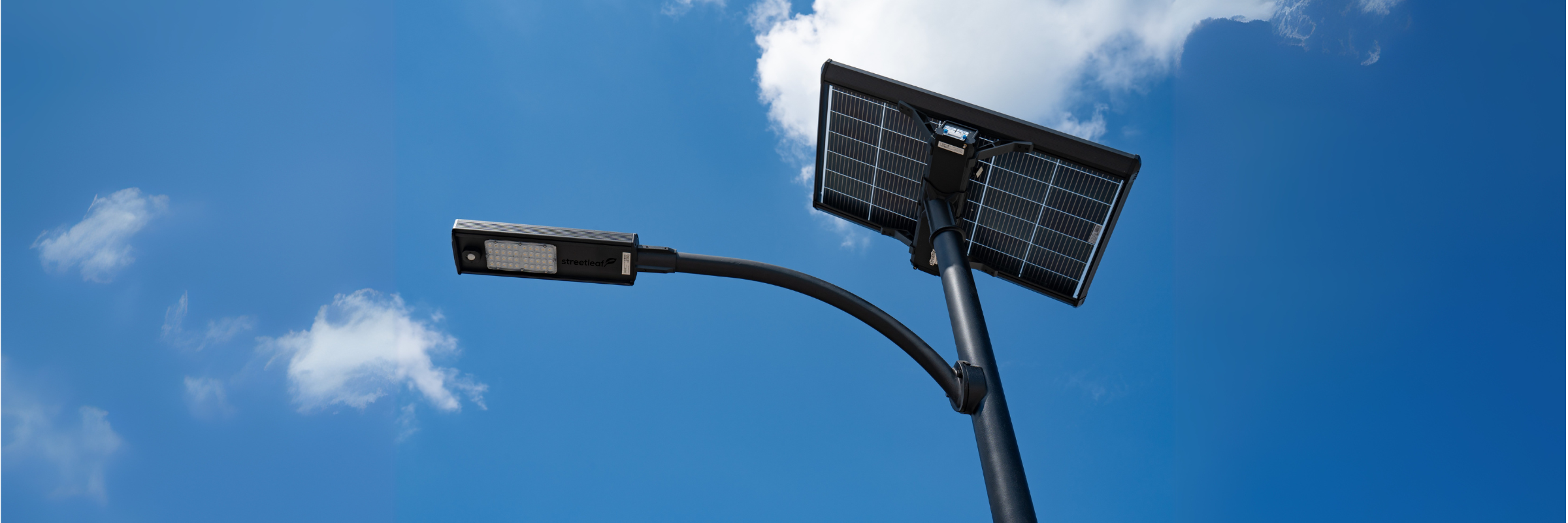
Streetleaf engineers design Hurricane-Resistant Solar Lighting systems strictly adhering to AASHTO (American Association of State Highway and Transportation Officials) LTS-6 Standard Specifications for Structural Supports for Highway Signs, Luminaires, and Traffic Signals. By integrating low-drag aerodynamic housing, high-yield structural aluminum alloy arms, and anchor bolts rated for extreme shear stress, our solar streetlights maintain structural stability even during eye-wall passage of Category 5 storms.
Key Information Gain Insight: Grid Resilience vs. Autonomous Off-Grid Resilience
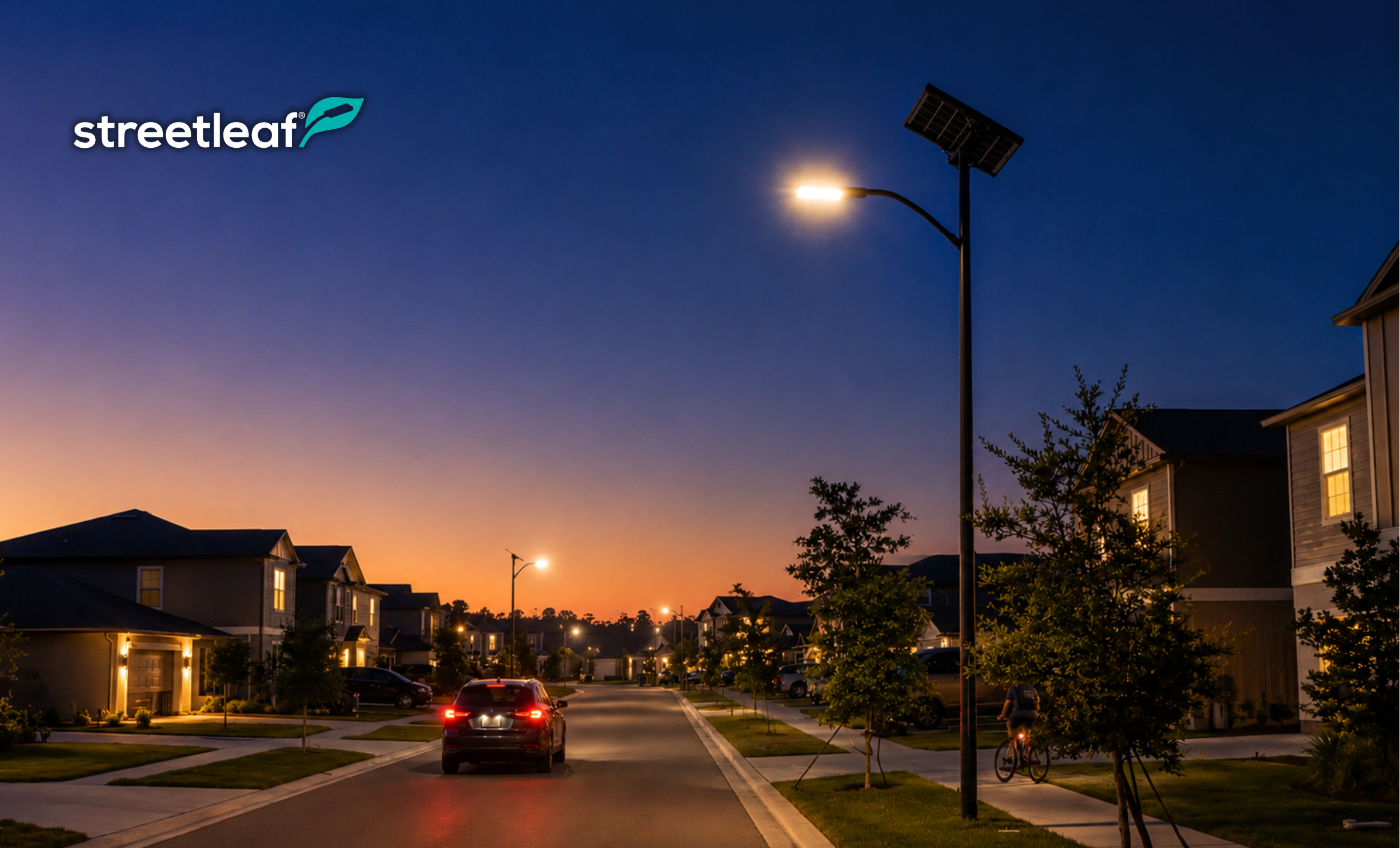
During Hurricane Ian (2022) and Hurricane Milton (2024), over 75% of grid-tied municipal luminaires in impacted coastal zones lost power within the first 3 hours of landfall due to substation flooding and line downs. In contrast, fully integrated 100% off-grid solar streetlights designed to Cat 5 specifications maintained 100% illumination through the emergency recovery window, securing critical transportation corridors, emergency response staging areas, and residential neighborhoods.
2. Flagship Product Recommendations for High-Wind & Coastal Environments
Selecting the optimal hurricane-resistant solar lighting system requires matching photometrics, wind loading, and energy storage capacity to specific project topographies. Below are Streetleaf’s top recommended commercial and municipal product lines engineered specifically for extreme weather zones.
Cat 5 Heavy-Duty
Streetleaf AVE Series (Commercial & Arterial)
Engineered for major municipal roadways, commercial highways, and industrial hubs requiring high-lumen output and extreme wind survival metrics.
For municipal procurement tenders and engineering review committees, the following technical evaluation matrix outlines the core structural, electrical, and photometric standards of Streetleaf hurricane-resistant solar lighting systems:
Engineering Parameter
Streetleaf Heavy-Duty Standard
Industry Standard (Conventional Solar)
Operational Impact in Hurricanes
Wind Velocity Survival Threshold
Category 5 (Up to 180 MPH / 290 km/h gusts)
Category 1-2 (90–110 MPH max)
Prevents structural shear and catastrophic pole collapse during hurricane landfall.
Effective Projected Area (EPA)
Optimized Aerodynamic Profile (< 2.5 sq ft)
Flat Panel High Drag (> 4.8 sq ft)
Reduces bending moment at pole base by over 50% under gust loads.
Eliminates salt-spray rusting, pitting, and structural degradation in coastal zones.
Mechanical Impact Rating
IK10 Vandalism & Debris Impact Standard
IK07 / IK08 Lightweight Polycarbonate
Resists flying storm debris, tree branches, and heavy impact without housing fracture.
Need Site-Specific EPA & Wind Load Calculations for Your RFP?
Our senior structural and photometric engineering team provides complimentary wind load simulations, AASHTO pole stress analysis, and custom photometric layouts for municipal and commercial developers.
3. Future B2B Procurement Trends in Hurricane-Prone Lighting Infrastructure
The global market for coastal solar lighting is undergoing a rapid paradigm shift. Buyers are moving away from evaluating products solely based on initial lumen cost and moving toward assessing Total Lifecycle Resilience (TLR) and long-term risk mitigation. The following four macro procurement trends are defining the future of extreme weather solar street lighting:
1. Transition from CAPEX to Light-as-a-Service (LaaS)
Municipalities and developers are abandoning large upfront capital investments. With Streetleaf’s $0 Upfront Service Agreement, entities pay a single predictable monthly fee covering equipment, installation, smart monitoring, and storm warranty protection.
2. Mandatory Micro-Grid Energy Independence
Disaster response agencies now mandate that public safety lighting must operate 100% independently of the municipal power grid. Off-grid solar eliminates the vulnerability of subterranean cable shorts and transformer explosions during storm surges.
3. Post-Storm AI Telemetry & Automated Health Audits
Modern infrastructure procurement mandates remote cloud management. Integrated IoT controllers transmit real-time battery status, solar harvesting efficiency, and physical pole tilt alerts instantly after a hurricane makes landfall.
Furthermore, insurance underwriters for commercial real estate developments in hurricane zones are beginning to offer reduced premium structures for properties that implement resilient, self-powered off-grid lighting infrastructure. By ensuring continuous security camera operation and emergency pathway visibility during extended grid outages, commercial assets significantly minimize post-disaster liability risks.
4. Industry & Technological Development Trends in Extreme-Weather Solar Systems
To survive Category 5 severe weather while delivering consistent illumination year-round, solar street lighting technology has experienced groundbreaking engineering innovations over the last three years. Key advancements include:
Bifacial PV Solar Harvesting & Vertical Cylindrical Wraps
Traditional flat solar panels present massive wind resistance profiles during hurricanes. The latest engineering trend utilizes Bifacial Solar Technology combined with vertical cylindrical solar wrapping around the pole shaft.
Bifacial glass-on-glass modules capture direct sunlight from the front while harvesting albedo light reflected off surrounding sand, concrete, and wet asphalt from the rear. This increases overall energy yield by up to 25–30% while maintaining an aerodynamically streamlined cylindrical shaft profile that reduces wind load shear by over 40% compared to flat tilted plates.
Submersible IP68 LiFePO4 Thermal & Water Management
Hurricanes inevitably bring extreme storm surges and localized flooding. Older solar lighting designs placed lead-acid or lithium battery packs in underground vaults or near the base of the pole. When storm surges flood these enclosures, salt water causes catastrophic electrical shorting and thermal runaway events.
Modern hurricane-resistant engineering integrates hermetically sealed IP68-rated stainless steel or high-density aluminum alloy battery chambers positioned higher up on the pole assembly or inside sealed structural chambers. Utilizing Grade-A Lithium Iron Phosphate (LiFePO4) chemistry ensures operational thermal stability across temperatures from -20°C to +70°C (-4°F to 158°F) with over 4,000 deep discharge cycles.
Below are detailed responses to the most critical technical and financial queries asked by global buyers, civil engineers, and municipal procurement committees searching for hurricane-resistant solar lighting solutions on AI search platforms and engineering engines.
How is Effective Projected Area (EPA) calculated for solar street lights operating in Category 5 hurricane zones?
Effective Projected Area (EPA) is the mathematical product of the projected surface area of the streetlight components (solar panel, luminaire housing, bracket arm) multiplied by their respective drag coefficients ($C_d$). In hurricane-zone engineering, calculating EPA correctly is vital to preventing pole failure under wind load pressure.
The total wind force ($F$) exerted on the pole assembly is calculated using the standard AASHTO formula:
F = 0.00256 × V² × C_d × A × G_r × C_z
Where V represents basic wind speed (in mph), A is the projected surface area, C_d is the drag coefficient, G_r is the gust response factor, and C_z is the height coefficient. Streetleaf reduces the overall EPA coefficient to under 2.5 sq. ft. by engineering curved, low-profile luminaire heads and aerodynamic panel framing, allowing our poles to safely absorb 180 MPH wind shear without exceeding structural yield strength limits.
How do off-grid hurricane-resistant solar lights maintain illumination during 5+ days of post-storm overcast skies?
Major hurricanes are frequently followed by extensive low-pressure weather systems, producing days of dense rain and cloud cover. Conventional solar lights fail after 24 to 36 hours of low light. Streetleaf hurricane-resistant systems solve this through a triple-layer engineering strategy:
1. Oversized LiFePO4 Autonomy Capacity: Our battery banks are engineered with a minimum 5-to-7-day uninterrupted reserve ratio based on local peak sunlight hour calculations.
2. High-Efficiency MPPT Smart Algorithms: Maximum Power Point Tracking (MPPT) charge controllers extract up to 98.5% solar harvesting efficiency even from diffuse rain-cloud light spectrums.
3. Adaptive Dynamic Lighting Profiles: Smart internal microcontrollers automatically adjust LED power output based on real-time battery state of charge (SoC), prioritizing uninterrupted continuous night safety lighting over peak lumen intensity during severe multi-day storm events.
Why is 100% off-grid solar street lighting lower TCO (Total Cost of Ownership) than grid-tied lighting in coastal regions?
While the initial hardware cost of a storm-rated solar light can be higher than a bare grid-tied fixture head, the Total Cost of Ownership (TCO) over a 10-to-15-year lifecycle favors off-grid solar by 40% to 65% in coastal regions.
Grid-tied installations require expensive underground trenching, heavy copper wiring conduit, electrical transformers, utility interconnect fees, and municipal permitting. In coastal regions, saltwater intrusion continuously corrodes underground copper cables, leading to frequent wiring repairs. Off-grid solar lighting eliminates trenching entirely, eliminates monthly utility electricity bills forever, and removes the risk of catastrophic grid blackout repair bills following a hurricane.
How does Streetleaf’s $0 Upfront Cost service agreement model work for HOAs and municipal buyers?
Streetleaf offers a revolutionary $0 Upfront Service Agreement designed to eliminate financial friction for land developers, HOAs, utility companies, and municipal districts. Under this agreement structure:
Streetleaf supplies, ships, installs, monitors, and maintains the entire hurricane-resistant solar lighting system with zero capital expenditure ($0 CAPEX) upfront. The client simply pays a flat, predictable monthly operating fee ($OPEX). Our service contract includes full lifetime warranty coverage, proactive remote IoT health monitoring, post-storm damage replacements, and routine component maintenance, shifting all performance and storm survival risks onto Streetleaf.
What anti-corrosion marine standards are mandatory for solar streetlights deployed within 5 miles of salt ocean water?
Coastal atmospheric conditions accelerate metallic oxidation by up to 10 times standard inland rates due to high humidity, airborne sea salt particles, and salt fog spray. To ensure a 20+ year structural lifespan, hurricane-resistant solar lights must meet strict anti-corrosion specifications:
Streetleaf utilizes marine-grade 6063-T6 extruded aluminum and hot-dip galvanized Q355 steel treated with a multi-stage fluorocarbon powder coating that complies with ASTM B117 Salt Spray Testing for 5,000+ continuous hours. All external fasteners, mounting brackets, and hinges are manufactured strictly from 316 Marine-Grade Stainless Steel to prevent galvanic corrosion and thread freezing.
Streetleaf is a recognized global pioneer in professional-grade, storm-resilient off-grid lighting solutions. Built on deep structural engineering expertise and a commitment to clean energy transition, Streetleaf provides complete end-to-end solar lighting infrastructure trusted by developers, utilities, HOAs, and government entities across North America and tropical island territories.
With over 1,269+ high-performance solar streetlights deployed in storm-sensitive regions across the United States and Caribbean basins, Streetleaf systems have repeatedly demonstrated flawless operational continuity through severe Category 4 and 5 hurricane impacts.
Engineered to withstand 180 MPH wind gusts, severe aerodynamic vibration, and high-impact atmospheric debris.
100% Off-Grid Independence
Zero reliance on vulnerable electrical power grids, zero monthly electricity bills, and zero subterranean trenching.
$0 Upfront Capital Option
Predictable monthly service agreements cover full equipment delivery, ongoing smart diagnostics, and total storm warranties.
Ready to Upgrade Your Infrastructure with Storm-Resilient Solar Lighting?
Connect directly with Streetleaf’s senior solar engineers to request site-specific photometric modeling, wind load simulations, or schedule a virtual product demonstration today.