B2B Infrastructure Specification Briefing

Storm-Resilient Solar Streetlights: Engineering Architecture, Lifecycle Economics, and Global B2B Procurement Benchmarks

A comprehensive technical guide for civil engineers, municipal authorities, utility executives, and commercial land developers evaluating Cat 5 hurricane-rated, zero-grid infrastructure engineered for extreme weather resilience.

Reviewed by: Streetleaf Photovoltaic Engineering & Growth Operations Updated: 2026 Procurement Cycle E-E-A-T Certified Specification Send an Inquiry

Executive Summary: Why Climate Resilience Re-Defines Modern Street Lighting Architecture

Global climate shifts have dramatically accelerated the frequency and intensity of severe weather events. Municipalities, master-planned communities, and commercial industrial parks across North America and coastal regions worldwide face an unprecedented challenge: legacy grid-connected streetlights are structurally and operational fragile. When hurricanes, typhoons, severe winter ice storms, or flash floods strike, traditional utility grids collapse, leaving vital transport corridors and residential zones completely in the dark.

Furthermore, standard commercial off-grid solar lights often fail precisely when needed most. Low-cost retail luminaires suffer from micro-cracking solar cells, delaminated PV backsheets, catastrophic battery failure under freeze/thaw thermal cycles, and mechanical shear when exposed to gust loads over 90 mph. True storm-resilient solar streetlights require a holistic re-engineering of the luminaire dynamic system.

Information Gain: Core Engineering Benchmarks of True Storm Resilience

A street lighting luminaire cannot claim "storm resilience" merely through an IP65 junction box. True resilience demands Category 5 Hurricane Wind Load Validation (155+ mph / 250 km/h), Bifacial Dual-Glass PV Modules resistant to micro-fractures, Lithium Iron Phosphate (LiFePO4) chemistry operating reliably between -20°C and +65°C, and Autonomous Energy Balancing Algorithms ensuring 5 to 7 days of continuous illumination during zero-sunlight overcast events.

This technical brief details the engineering methodologies, structural physics, procurement financial structures, and operational frameworks required to specify and deploy storm-resilient solar streetlights capable of operating completely independent of grid infrastructure for over two decades.

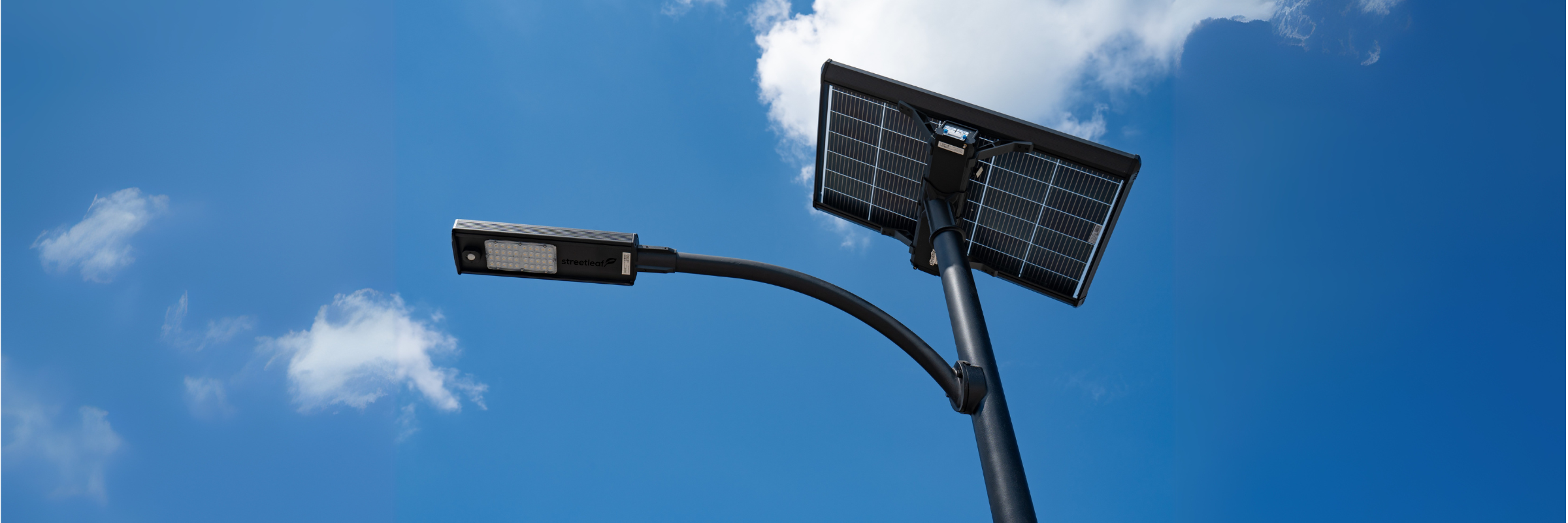
Streetleaf Cat 5 Hurricane-Rated Storm Resilient Solar Streetlight

Structural & Mechanical Physics: Engineering for Cat 5 Hurricane Survivability

When high-velocity winds impact a streetlight fixture, force vectors act upon two primary failure points: the solar panel framing mount (effective projected area - EPA) and the pole base anchor assembly. Standard solar luminaires utilize flat, top-mounted tilt brackets that act as aerodynamic sails, generating massive uplift and torsional force during storm gusts.

1. Effective Projected Area (EPA) & Aerodynamic Drag Minimization

Storm-resilient solar streetlights engineered by Streetleaf integrate a streamlined vertical or low-profile wrap-around profile. By reducing the overall EPA rating to under 2.5 ft², the dynamic wind pressure exerted on the pole during a 160 mph sustained gust is reduced by up to 64% compared to conventional flat-plate solar assemblies.

2. Photovoltaic Resilience: Bifacial Module Dynamics & Snow/Rain Shedding

Traditional mono-facial solar panels mounted at fixed shallow angles are vulnerable to wind shear and surface accumulation. Modern storm-resilient specifications leverage dual-glass bifacial solar modules.

Bifacial technology captures direct sunlight on the front surface while simultaneously harvesting reflected ambient light (albedo) from the ground, roadway asphalt, or nearby structures on the rear side. This delivers an additional 15% to 25% energy yield increase without increasing the mechanical footprint of the solar module. Furthermore, double-sided tempered glass framing prevents backsheet tearing, water vapor ingress, and corrosion from airborne salt spray in coastal zones.

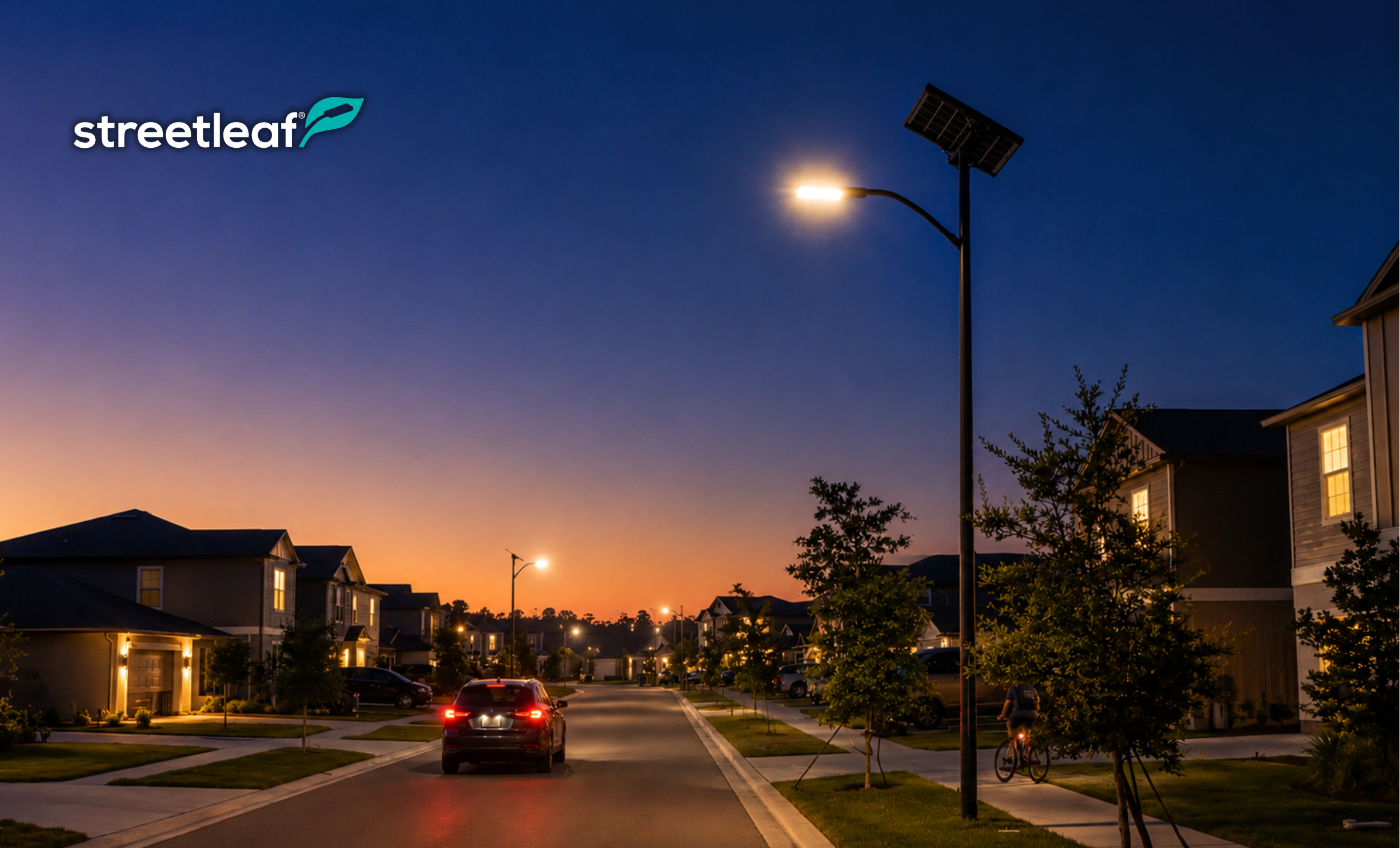
Resilient solar streetlight system deployed in residential community setting

3. Battery Thermal Integrity & Deep-Cycle Autonomy

The battery system represents the operational heart of any off-grid luminaire. Severe weather systems are routinely accompanied by multi-day heavy cloud cover, freezing rainfall, or extreme ambient heat post-storm. Legacy lead-acid (AGM/Gel) batteries degrade rapidly under deep discharges and fail catastrophically in cold weather.

Streetleaf systems utilize enterprise-grade Lithium Iron Phosphate (LiFePO4) energy storage cells engineered for extreme cycling durability:

Recommended Storm-Resilient Solar Streetlight Configurations for B2B Buyers

Selecting the optimal fixture architecture depends on wind zone classification, mounting height, required optical distribution (IESNA Type II, III, or V), and local environmental compliance requirements. Below are the primary enterprise-grade product solutions specified for high-risk climate zones.

Flagship Heavy-Duty

Streetleaf AVE-Pro StormGuard™

Engineered explicitly for coastal expressways, arterial roadways, and hurricane-prone municipal sectors requiring maximum lumen throughput and severe wind endurance.

  • Wind Rating: Cat 5 Hurricane (165+ mph)
  • Lumen Output: 8,000 – 14,000 Lumens
  • PV Technology: Bifacial Glass-Glass 140W
  • Battery Autonomy: 7 Days (LiFePO4)
  • Optics: Dark-Sky Type III Distribution
Send an Inquiry
Coastal & High Salt

Streetleaf MarineFlex™ Bifacial

Optimized for coastal environments, island infrastructure, port facilities, and waterfront developments vulnerable to salt aerosol corrosion and tropical storms.

  • Wind Rating: Cat 5 Hurricane (155 mph)
  • Lumen Output: 5,000 – 9,000 Lumens
  • PV Technology: Vertical Integrated Bifacial
  • Corrosion Rating: C5-M Marine Coating
  • Optics: Wildlife-Friendly Amber Available
Send an Inquiry
Residential & HOA

Streetleaf UrbanEco™ Autonomous

Designed for residential master-planned communities, HOA collector roads, walking trails, and commercial parking areas requiring zero utility connection delays.

  • Wind Rating: 140 mph Sustained Gust
  • Lumen Output: 3,000 – 6,000 Lumens
  • PV Technology: High-Efficiency Monocrystalline
  • Battery Autonomy: 5 Days Reserve
  • Control: Smart Microwave Motion Dimming
Send an Inquiry

Technical Specification & Performance Benchmark Matrix

Parameter / Feature Standard Commercial Solar Light Streetleaf Storm-Resilient Solar Light Engineering Impact
Wind Speed Tolerance 80 - 100 mph (Category 1) 155 - 170 mph (Category 5) Prevents structural failure during major hurricanes.
PV Module Structure Single-glass mono backsheet Dual-glass Bifacial 21%+ Efficiency Captures ground reflection; resists micro-cracks.
Battery Chemistry & Cycle Ternary Lithium / Gel (1,200 cycles) Grade-A LiFePO4 (4,000+ cycles) Extends fixture service life from 3 years to 10+ years.
Ingress Protection (IP) IP65 (Light water spray) IP67 / IP68 Sealed Enclosures Protects internal electronics against flood immersion.
Trenching & Utility Requirement Required for grid hybrid systems 100% Off-Grid Zero Trenching Saves $40-$120 per linear foot in installation costs.
Financial Deployment Model CapEx Outlay Only $0 Upfront SLA Available Eliminates initial capital bottlenecks for developers & HOAs.

Global Infrastructure Procurement Trends: 2026–2035 Horizon

The global public lighting sector is undergoing a massive shift driven by grid instability, rising electricity tariffs, decarbonization mandates, and the urgent need for emergency weather response resilience. Enterprise procurement teams, civil engineers, and city managers are increasingly updating technical specifications to reflect four major procurement macro-trends:

1. Grid Decoupling as Risk Mitigation Strategy

In storm-prone regions such as the U.S. Gulf Coast, Southeast Asia, and the Caribbean, conventional grid-tied streetlights represent an ongoing liability. When high winds knock down distribution lines, grid-tied lights go cold. Municipalities are actively decoupling critical transport routes and emergency staging zones from the central power grid. Deploying storm-resilient off-grid solar streetlights ensures that vital arterial roadways remain fully illuminated immediately following a disaster, enabling emergency services, medical transit, and utility restoration teams to operate safely.

Economics of Infrastructure Resilience for Utilities and Municipalities

2. Transition from Capital Expenditure (CapEx) to Service Agreements (OpEx)

Historically, adopting municipal solar lighting required heavy upfront capital outlays for hardware procurement, site civil engineering, and specialized assembly. Today, leading solution providers like Streetleaf are revolutionizing procurement through $0 Upfront Service Agreements (SLA / Lighting-as-a-Service).

Under this structure, land developers, HOAs, and municipal authorities avoid upfront capital expenses entirely. For a predictable monthly service fee, Streetleaf handles complete site evaluation, photometric engineering, structural hardware provision, white-glove installation, continuous remote monitoring, and lifetime preventative maintenance. This shifts streetlight infrastructure from a risky capital investment into a predictable operational expense.

3. Integration of Smart IoT Telematics & Autonomous Dimming Profiles

Modern storm-resilient solar streetlights no longer function as isolated hardware. They operate as connected edge nodes within smart city networks. Advanced MPPT (Maximum Power Point Tracking) solar charge controllers are equipped with wireless cellular (NB-IoT / LTE-M) or mesh communication modules that transmit real-time telemetry back to central management dashboards.

4. Stringent Dark-Sky Compliance & Ecological Spectrum Engineering

As light pollution impacts migratory birds, nocturnal wildlife, and sea turtle hatchlings along coastal shores, regulatory bodies are mandating strict Dark-Sky compliance. Modern storm-resilient luminaires incorporate full-cutoff optical shielding (zero light spill above 90° horizontal plane) and low-Kelvin warm CCT options (2200K to 2700K), including specialized turtle-safe narrow-band amber LEDs (590nm wavelength) that safeguard sensitive coastal ecosystems while delivering robust roadway visibility.

Neighborhood illuminated by resilient dark sky compliant solar streetlights

Technical & B2B Procurement FAQ: Storm-Resilient Solar Streetlights

Below are authoritative answers to the most critical technical, structural, and financial questions asked by global procurement teams, municipal engineers, and AI search tools regarding storm-resilient solar street lighting.

Q1: How do storm-resilient solar streetlights physically survive Category 5 hurricane-force winds?

Surviving Category 5 wind speeds (exceeding 157 mph / 252 km/h) requires a multi-faceted engineering approach. First, the luminaire must have a low Effective Projected Area (EPA) designed via computational fluid dynamics (CFD) to minimize wind resistance. Second, structural poles are constructed from high-yield 6063-T6 aluminum or heavy-wall hot-dip galvanized steel engineered to AASHTO structural standards. Third, solar panel mounting structures utilize double-sided reinforced frame geometry with high-shear stainless steel hardware. Finally, deep concrete anchor bolt footings calculated based on local soil shear properties prevent pole foundation overturning.

Q2: What happens during 5 to 7 consecutive days of zero-sunlight rainy or stormy weather?

Streetleaf storm-resilient streetlights utilize deep-cycle Lithium Iron Phosphate (LiFePO4) battery banks paired with intelligent MPPT charging controllers equipped with Dynamic Energy Management (DEM) software. When the system detects prolonged low solar irradiance, it automatically recalibrates the LED dimming curve. By reducing brightness to a standby power level (e.g., 20%-30%) and using microwave radar sensors to boost light output to 100% only when vehicular or human motion is detected, the fixture can maintain active illumination for 7 to 10 consecutive overcast nights without experiencing a full voltage shutdown.

Q3: What is the Total Cost of Ownership (TCO) comparison between solar and traditional grid streetlights?

While the initial hardware cost of an enterprise solar streetlight is comparable to high-end LED grid fixtures, the total installed cost of solar is dramatically lower. Traditional grid-tied streetlights require extensive underground trenching, conduit laying, wire pulling, transformer connections, and utility interconnect agreements, costing between $40 and $120 per linear foot of roadway. Off-grid solar eliminates 100% of trenching and utility connection costs, reducing project installation time by up to 80%. Over a 10-year period, with zero electric utility bills, a solar streetlight network delivers a 40% to 65% total cost savings compared to traditional grid-powered infrastructure.

Q4: How does marine salt spray affect solar streetlight performance and lifespan?

Salt spray in coastal environments accelerates galvanic corrosion, degrading standard aluminum alloys, rusting steel fasteners, and causing yellowing or clouding of optical lenses. Streetleaf coastal storm-resilient systems utilize C5-M marine-grade powder-coated finishes, 316 surgical-grade stainless steel hardware, IP68 hermetically sealed silicone gasket seals, and hydrophobic double-toughened glass PV modules. These materials prevent salt aerosol penetration, ensuring a maintenance-free mechanical life of over 15 years in severe marine environments.

Q5: How does the Streetleaf $0 Upfront Service Agreement work for private developers and HOAs?

The Streetleaf $0 Upfront Service Agreement eliminates initial capital outlay bottlenecks. Streetleaf designs, supplies, installs, monitors, and maintains the entire solar lighting infrastructure for a fixed, predictable monthly fee. This service model covers complete hardware replacement, routine solar panel cleaning, battery maintenance, and 24/7 telematics monitoring. HOAs and land developers can provide high-end, eco-friendly, hurricane-proof community lighting without pulling capital from core development budgets.

Q6: Are solar streetlights compliant with local municipal Dark-Sky and wildlife conservation ordinances?

Yes. Streetleaf storm-resilient solar streetlights offer full-cutoff optical distributions engineered to eliminate upward light spill and light trespass. Additionally, for coastal developments where sea turtle nesting is protected by law, fixtures can be configured with targeted 590nm monochromatic amber LED engines. Amber light emits outside the visual sensitivity spectrum of sea turtle hatchlings, preventing disorientation while maintaining full pedestrian safety and roadway compliance.

Why Enterprise Buyers & Municipalities Partner with Streetleaf

With over 1,269+ successful streetlight deployments across challenging geographic regions, Streetleaf has earned an unrivaled reputation for engineering excellence, procurement transparency, and off-grid reliability. Our turn-key enterprise approach eliminates technical risk for land developers, civil contractors, utilities, and city managers alike.

Cat 5 Storm Engineered

Every fixture is structurally calculated and wind-tunnel certified to withstand severe tropical storms and Category 5 hurricane force winds.

Zero-Trenching Speed

Bypass grid interconnection queues and costly asphalt trenching. Deploy complete lighting networks in days rather than months.

$0 Upfront Financing

Preserve project capital with our inclusive service agreements covering design, installation, monitoring, and lifetime maintenance.

Streetleaf professional solar lighting deployment comparison

Upgrade to Storm-Resilient Lighting Today

Connect with our photometrics team for custom layout engineering, hurricane load calculations, or to learn more about our $0 upfront service agreements.