All-in-Two Series
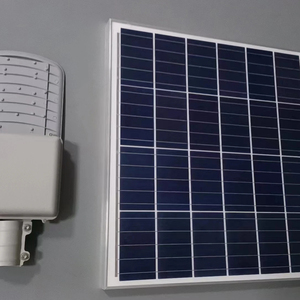
All in Two Outdoor Solar Street Light Two in One
- Ultra-Efficacy: Up to 210 lm/W
- Adjustable Bracket: 0° to 60° Tilt
- Battery: Deep-Cycle LiFePO4

Tested under ISO 9001, CE, RoHS, IP66, and IK10 standards for global municipal roadways, commercial complexes, and rural electrification projects.
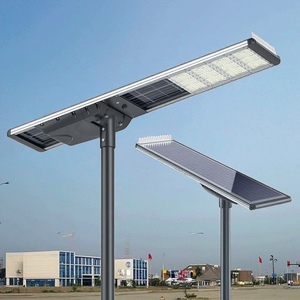
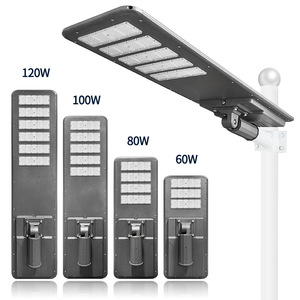
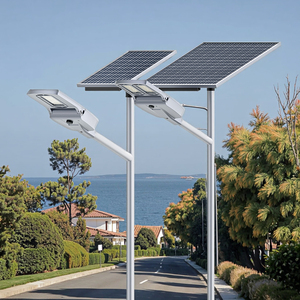
Why Tier-1 civil engineering contractors, municipal authorities, and international importers partner with leading solar lighting manufacturers in China.
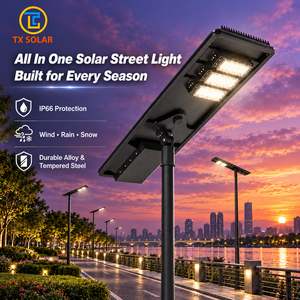
Engineered for vulnerable coastal corridors and severe weather zones, our luminaires undergo rigorous wind-tunnel testing up to 165 mph (74 m/s). Built with die-cast ADC12 aluminum structural housings, stainless steel 316 anti-corrosion hardware, and tempered impact glass certified to IK10 standards.
Transitioning beyond standard PERC cells, our high-efficiency solar lighting systems incorporate bifacial dual-glass TOPCon photovoltaic modules. By harvesting both direct overhead sun rays and ground-reflected albedo light, solar conversion yield increases by 15% to 28%, ensuring rapid battery charging even on overcast days.
For municipal clients and land developers navigating tight capital budgets, our export programs offer flexible funding structures. We support customized service agreement frameworks where initial hardware acquisition can be structured with $0 upfront cost, offset by long-term power savings and zero electrical grid trenching fees.
Protect local ecosystems and urban astronomy requirements. Our optical assemblies feature precise batwing light distribution and full cut-off shields (ULR = 0%). We also supply 590nm narrow-spectrum amber LEDs engineered specifically for sea turtle conservation zones along coastal highways.
Powered exclusively by new, Grade-A Lithium Iron Phosphate (LiFePO4) battery packs featuring advanced active BMS balancing. Designed for deep discharges without thermal degradation, offering over 3,500 lifecycle cycles at 80% DoD and providing 5 to 7 days of continuous illumination during consecutive cloudy or rainy weather.
Integrate streetlights directly into smart city dashboards via integrated LoRaWAN, NB-IoT, or Zigbee controllers. Features include real-time power consumption telemetry, remote dimming scheduling, automatic fault detection alerts, and microwave radar motion sensing to minimize unnecessary energy draw.
A comprehensive analysis of technological shifts, supply chain evolutions, and ESG regulatory mandates impacting commercial importers and municipal buyers.
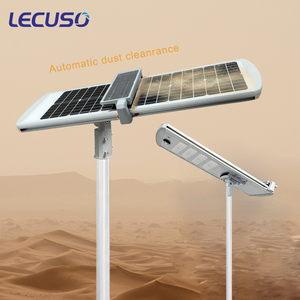
Dust, particulate matter, and sand accumulation in arid regions can cause up to a 40% reduction in photovoltaic charging efficiency within three months. Procurement trends indicate a sharp rise in demand for self-cleaning solar streetlights equipped with integrated robotic wipers or hydrophobic anti-soiling nano-coatings. This shift reduces municipal maintenance operational expenses (OPEX) by up to 70% over the luminaire’s 10-year lifecycle.
To support higher wattage requirements for multi-lane arterial expressways (80W to 200W LED fixtures), Chinese manufacturers are moving away from traditional 12V DC systems to 24V and 36V architectures. Higher operating voltages significantly lower internal current (Amperage), reducing resistive thermal losses across cabling and extending the overall operating lifespan of internal electronic driver components and LiFePO4 battery cells.
International procurement tenders—especially across North America, Europe, and the Middle East—now frequently mandate Environmental Product Declarations (EPD). Leading Chinese exporters are conducting full Life Cycle Assessments (LCA), tracing raw material sourcing from aluminum smelting to battery cell manufacturing. Buyers gain a distinct advantage by sourcing fixtures produced in ISO 14064 carbon-neutral certified factories.
Future-proofing public lighting assets is critical. Modern procurement specifications demand luminaires fitted with standardized 7-pin NEMA or Zhaga Book 18 sockets. This modular design allows municipalities to deploy basic off-grid solar streetlights today and seamlessly snap on smart IoT nodes, traffic monitoring cameras, or air quality sensors years later without replacing the fixture core.
Evaluating economic efficiency, structural reliability, and operational capabilities across outdoor lighting technologies.
| Performance Metric | Traditional Grid-Connected LED | Generic Off-Grid Solar Light | China Next-Gen High-Efficiency Solar |
|---|---|---|---|
| System Luminous Efficacy | 120 - 140 lm/W | 130 - 160 lm/W | 190 - 220 lm/W |
| Solar Panel Efficacy & Type | N/A (Grid Powered) | 17% - 19% Poly / Monocrystalline | 23.5% N-Type TOPCon Bifacial |
| Battery Life Expectancy | N/A | 2 - 3 Years (Lead-Acid / Low-Tier Li-ion) | 8 - 12 Years (Grade-A LiFePO4) |
| Trenching & Cabling Cost | High ($25 - $70 / Linear Meter) | Zero ($0) | Zero ($0) |
| Maximum Wind Load Rating | Dependent on Pole Pole Specs | 110 mph (Cat 2 Storms) | 165 mph (Cat 5 Hurricane Rated) |
| Cloudy/Rainy Autonomy | 0 Days during Grid Outage | 1 - 2 Days Maximum | 5 - 7 Days (With Smart MPPT / ALS) |
| IoT & Central Management | Requires Wired Controls | Basic PIR Sensor Only | LoRaWAN / NB-IoT Cloud Telemetry |
Technical, logistical, and commercial inquiries answered by senior solar lighting manufacturing engineers.
Streamline your B2B procurement with direct factory engineering expertise, customized DIALux photometric simulations, and competitive OEM/ODM export pricing.
Contact Us