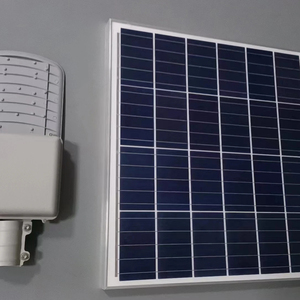
All in Two Outdoor Solar Street Light Two in One
Split Battery
High Efficacy
IP66 Rated

Engineered for extreme environmental durability, high luminous efficacy, and zero grid dependency. Select your configuration below to request immediate technical specifications and factory-direct B2B pricing.
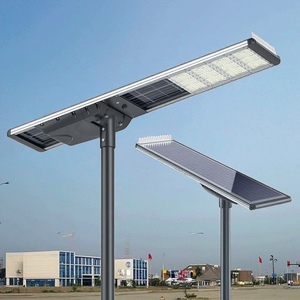
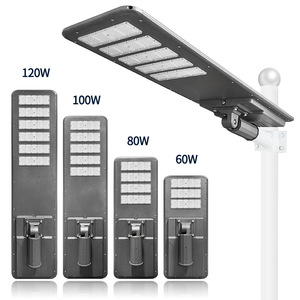
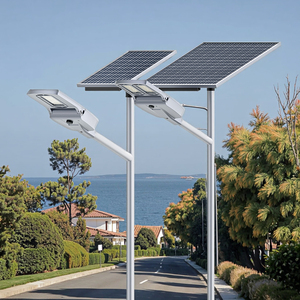
Selecting the optimal off-grid lighting architecture requires balancing luminaire wattage, geographical solar irradiance, thermal envelope boundaries, and severe weather exposure. Below is an engineering trade-off analysis conducted by our senior photovoltaic lighting specialists.
In modern municipal and commercial infrastructure planning, the choice between Split-Type Solar Lighting Systems and Integrated (All-in-One) Solar Lights defines the operational lifespan and Levelized Cost of Energy (LCOE). Split-type solar street lights decouple the photovoltaic module, battery storage enclosure, and LED luminaire engine. This separation allows engineers to independently optimize each component for maximum efficiency and thermal longevity.
| Performance Metrics | Split-Type Solar Systems | Integrated (All-in-One) Systems | Municipal Engineering Impact |
|---|---|---|---|
| PV Module Scaling | Unlimited (Up to 400W+ Mono-crystalline panels) | Constrained to luminaire body size (30W - 120W) | Split-type enables 100% duty cycle in low-sun-hour regions. |
| Thermal Battery Management | Underground / Pole-Base mounting options (25°C ambient) | Direct exposure to internal LED heat & solar radiation (55°C+) | Split-type extends LiFePO4 battery lifespan by 300% (Up to 12 years). |
| Wind Loading & Tilt Precision | Independent 0–60° adjustable solar tilt angles | Fixed parallel alignment to pole angle | Split-type yields up to 35% higher energy capture annually. |
| Maintenance & Modular Swapping | Component-level replacement (LED, Driver, or Battery) | Full luminaire tear-down required | Split-type lowers lifetime OPEX for municipal road departments. |
| Windstorm Resilience Rating | Classified for Category 5 Storms (Up to 165 mph / 74 m/s) | Limited by aerodynamic profile of large integrated bodies | Superior structural integrity in hurricane-prone coastal zones. |
Combining state-of-the-art automated manufacturing, rigorous ISO9001/14001 quality validation, and deep photovoltaic domain expertise to deliver reliable lighting infrastructure.
Our engineered split-type mounting brackets and reinforced Q235 galvanized steel poles undergo rigorous wind tunnel validation up to 165 mph. Built to maintain operational stability during severe coastal storms and typhoons.
Utilizing N-Type TOPCon bifacial glass-glass solar panels, our split systems capture direct sun rays alongside ground-reflected albedo light, boosting total power yield by up to 28% in snowy, sandy, or concrete environments.
Equipped exclusively with premium Lithium Iron Phosphate (LiFePO4) battery packs featuring smart BMS protection. Rated for over 4,000 deep discharge cycles (80% DoD) for more than a decade of maintenance-free service.
Designed with zero-uplight full-cutoff optics and custom CCT profiles (down to 2200K amber). Protects nocturnal wildlife, meets Dark-Sky standards, and reduces light pollution near coastal sea turtle nesting areas.
Integrate every pole into your smart city network via LoRaWAN, Zigbee, or Cellular NB-IoT. Monitor battery state-of-charge, adjust dynamic dimming schedules, and trigger automated fault alerts remotely.
We support land developers, HOAs, and municipalities with direct OEM purchasing as well as structured service agreements ($0 upfront cost options), transferring long-term maintenance burdens to reliable hands.
An in-depth look at regulatory shifts, technological breakthroughs, and financial structures shaping global outdoor lighting procurement through 2030.
The next decade of solar lighting efficiency is defined by optical utilization rather than raw solar panel wattage. By leveraging high-efficacy LED chips operating up to 220 lumens per watt, modern split-type luminaires require 40% less photovoltaic area and smaller battery reserves while achieving IESNA-compliant foot-candle levels on municipal arterial roadways.
Static lighting profiles are being replaced by adaptive AI-driven MPPT controllers. Modern split-type solar street lights continuously analyze real-time meteorological forecasts, historical solar harvest metrics, and local pedestrian/traffic motion trends to adjust dynamic dimming curves dynamically—guaranteeing 100% illumination uninterrupted across 7 consecutive rain or snow days.
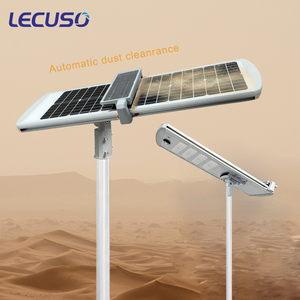
Dust, sand, and particulate accumulation on photovoltaic panels can degrade power output by up to 60% within 90 days in arid regions. As utility-scale solar lighting expands across desert highways and Middle Eastern/North African industrial corridors, auto-clean self-cleaning solar street light models featuring integrated motorized cleaning wipers are becoming standard tender requirements.
Governments and corporate developers are increasingly mandating environmental product declarations (EPDs). The split-type architecture aligns with sustainability guidelines by enabling individual component swaps (replacing a battery pack or driver module after 10 years) without disposing of the structural steel pole or glass solar module, significantly cutting carbon footprints.
Technical guidance addressing the design, installation, battery management, and procurement of split-type solar street lighting systems.
Split-type solar street lights are essential for applications requiring luminaires above 60W or continuous high-output illumination. Integrated all-in-one lights are physically limited by the solar panel size mounted on top of the fixture. Split systems allow you to size a solar panel (up to 400W+) independently to match heavy power requirements, high latitudes with low solar angles, or prolonged monsoon conditions while keeping the battery isolated from heat generated by the LED luminaire engine.
Our split-type solar street lights feature structural Q235/Q345 hot-dip galvanized steel framing, high-tensile stainless steel fasteners, and aerodynamic brackets. The separation of components allows engineers to calculate wind pressure coefficients precisely and use low-drag mounts. The system is validated through Finite Element Analysis (FEA) and wind tunnel testing to withstand gust velocities up to 165 mph (74 m/s).
We use Grade-A Lithium Iron Phosphate (LiFePO4) cell chemistry, offering 4,000+ charge-discharge cycles at 80% Depth of Discharge (DoD), translating to an 8–12 year operational lifespan. In split configurations, the battery can be mounted high on the pole in a ventilated IP67 cabinet or buried underground in a IP68 battery box. Underground installation maintains a steady ambient temperature (~20°C–25°C), protecting battery health from extreme atmospheric heat or freezing surface weather.
Yes. Our split systems can be integrated with optional smart control nodes utilizing LoRaWAN, Zigbee, or 4G/NB-IoT wireless communication protocols. This allows municipal operations teams to monitor energy harvesting metrics, battery state-of-charge, and luminaire status in real time. It also supports remote dimming scheduling, automated maintenance alerts, and adaptive motion-sensing adjustments from a centralized dashboard.
As a direct manufacturer, we provide end-to-end customization for government and enterprise lighting contracts. Key specs tailored to your project include: specific LED chip arrays (Bridgelux, Lumileds, Cree), custom beam distributions (IESNA Type I, II, III, IV, or V), color temperature control (2200K to 6500K), adjustable tilt angle brackets, pole height options (4m to 14m), extended battery autonomy days, and specialized powder-coating colors for marine environment corrosion resistance (C5-M class coatings).
Whether you are designing a high-latitude municipal roadway, a coastal commercial park, or an off-grid industrial complex, our engineering team provides complete photometric calculations (DIALux), custom system sizing, and direct factory pricing.