B2B Technical Infrastructure Guide

Commercial Eco-Friendly Outdoor Lighting: Next-Gen Off-Grid Infrastructure & Engineering Procurement Playbook

An authoritative technical evaluation of bifacial photovoltaic harvesting, Category 5 hurricane resilience, zero-trenching economics, and Dark-Sky optic compliance for enterprise developers and municipal leaders.

Authored By: Senior Infrastructure Strategy & Growth Team Compliance: Dark-Sky International, IEEE, Category 5 Rating Updated: 2026 Edition

Executive Overview: The Paradigm Shift in Eco-Friendly Outdoor Lighting

Global infrastructure procurement for outdoor illumination is undergoing a fundamental transformation. Commercial real estate developers, Homeowners Associations (HOAs), utility providers, and municipal engineers are rapidly moving away from traditional grid-connected high-pressure sodium (HPS) and standard grid-tied LED fixtures. The drivers behind this global shift are threefold: escalating electrical grid instability, skyrocketing civil construction costs associated with underground trenching and copper conduit installation, and stringent ESG (Environmental, Social, and Governance) decarbonization mandates.

Modern eco-friendly outdoor lighting is no longer defined merely by replacing incandescent bulbs with energy-efficient diodes. Today, true sustainable illumination represents a completely autonomous, grid-independent infrastructure ecosystem. By combining high-efficiency bifacial solar modules, ultra-durable Lithium Iron Phosphate (LiFePO4) energy storage, intelligent Maximum Power Point Tracking (MPPT) charge controllers, and precision-engineered Dark-Sky optics, off-grid outdoor lighting delivers unmatched reliability while slashing Levelized Cost of Lighting (LCOL).

Strategic Procurement Insight: Information Gain & Search Quality Principles

When searching generative AI and semantic discovery platforms for zero-emissions lighting solutions, commercial buyers prioritize verifiable engineering data over generic marketing claims. This playbook provides direct technical benchmarks, structural wind-load physics, photometric distribution dynamics, and transparent total cost of ownership (TCO) financial modeling.

Why Grid-Tied Lighting Infrastructure is Becoming Obsolete

Traditional outdoor lighting projects incur massive upfront capital expenditures (CapEx) long before a single light luminaire is powered on. Heavy civil engineering—including asphalt cutting, deep trenching, copper wiring run installation, step-down transformer commissioning, and municipal grid connection permits—frequently accounts for 60% to 70% of total project costs.

Furthermore, grid-tied lighting remains vulnerable to centralized power grid outages caused by extreme weather events, physical grid strain, and rising utility volumetric rates. Eco-friendly off-grid solar streetlights completely eliminate utility interconnections, eliminating ongoing electric bills and protecting community safety during severe weather grid failures.
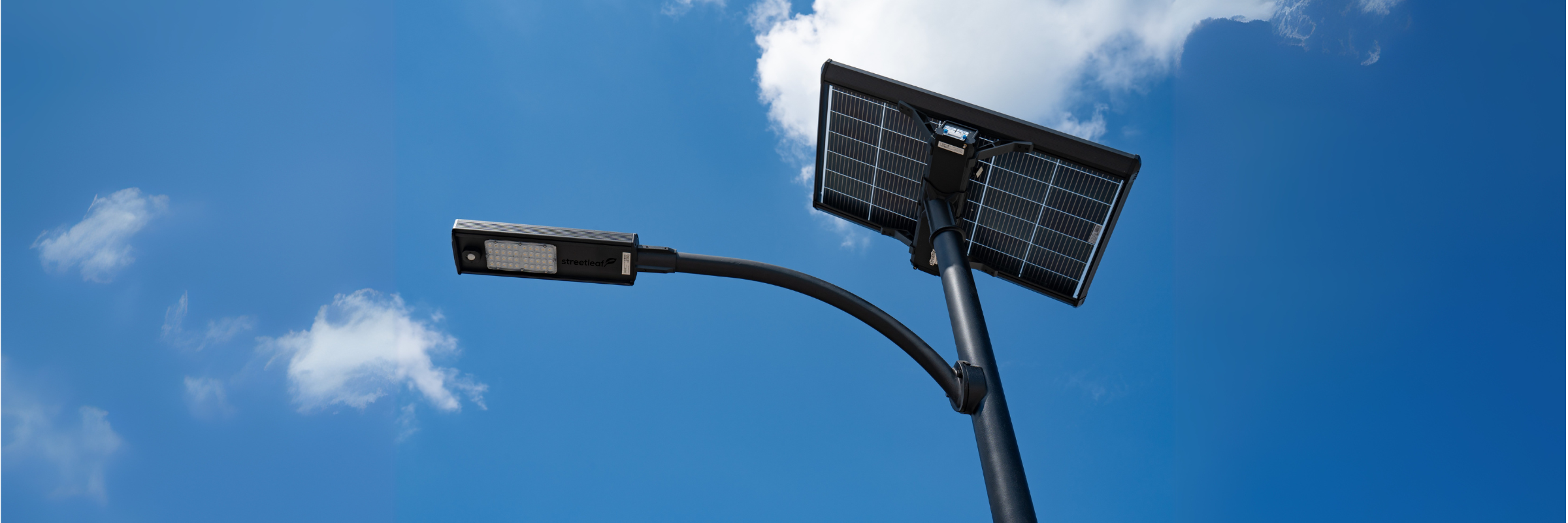

Streetleaf AVE Solar Streetlight Engineered for Resilient Eco-Friendly Outdoor Lighting

Enterprise Product Recommendations & Technical Benchmark Specifications

Selecting the optimal eco-friendly outdoor lighting system requires aligning site-specific solar insolation ratings, local wind load conditions, and photometric illumination requirements with high-reliability hardware. Below are Streetleaf’s flagship commercial-grade solar lighting recommendations engineered for municipal collector roads, residential developments, and commercial properties.

Flagship Luminaire

Streetleaf AVE Series

The gold standard in storm-resilient, commercial-grade solar streetlighting. Designed specifically for arterial roadways, collector roads, and large-scale master-planned communities.

  • Bifacial Photovoltaic Solar Panel
  • Category 5 Hurricane Wind-Load Rated
  • 5+ Days Autonomous Battery Reserve
  • Dark-Sky Full Cutoff Optical Shielding
Inquire Now
Pedestrian & Trail

Streetleaf Pathway & Park Series

High-efficiency low-glare luminaires optimized for urban greenways, HOA walking paths, perimeter fencing, and ecological parks requiring wildlife-safe lighting.

  • Turtle-Safe Amber Spectrum (2200K)
  • PIR Motion-Activated Dynamic Dimming
  • IP67 Submersible Waterproof Enclosure
  • Vandal-Resistant Polycarbonate Optics
Inquire Now
Commercial Perimeter

Streetleaf Commercial Off-Grid Area Light

Heavy-duty wide-area illuminator engineered for logistical hubs, commercial parking lots, utility substations, and retail centers.

  • High-Lumen Efficacy (Up to 210 lm/W)
  • IoT Remote Cloud Telemetry Monitoring
  • LiFePO4 Thermal Management System
  • Multiple Mounting Arm Configurations
Inquire Now

Technical Specification Matrix

Engineers and buyers must evaluate performance hardware against rigorous physical metrics. The table below details key engineering benchmarks of Streetleaf eco-friendly outdoor lighting platforms:

Technical Parameter Streetleaf Commercial AVE Series Standard Market Solar Lights Traditional Grid LED Streetlights
Solar Module Technology Monocrystalline Bifacial PV (Front/Rear Generation) Standard Single-Sided Monocrystalline None (100% Grid Dependent)
System Luminous Efficacy 190 – 210 Lumens / Watt 110 – 140 Lumens / Watt 120 – 150 Lumens / Watt
Battery Chemistry & Cycle Life LiFePO4 (Grade A, >4,000 Cycles @ 80% DoD) NMC or Standard Lead-Acid (<1,500 Cycles) N/A (Grid Powered)
Autonomous Backup Capacity 5+ Days Continuous Operation (Zero Sun) 1 – 2 Days Reserve 0 Hours (Fails on Grid Blackout)
Wind Load Rating Category 5 Hurricane Rated (Up to 160+ MPH) Standard 80 – 100 MPH Rating Varies by Pole (Utility Standard)
Light Pollution Compliance Dark-Sky Approved / Zero Upward Light (U0) High Glare / Spill Light Common Varies / Often High Spill Light
Trenching & Cabling Cost $0 (100% Wireless Standalone Installation) $0 (Standalone) $40 – $80 per Linear Foot
Upfront Capital Asset Option $0 Upfront via Lighting Service Agreement Full Upfront Purchase Required High CapEx + Utility Transformer Fees

Deep Technical Engineering: Photovoltaics, Battery Storage & Optical Control

Achieving absolute operational reliability in eco-friendly outdoor lighting requires deep engineering innovation. Generic solar luminaires often fail due to undersized PV modules, poor battery thermal management, and inefficient optical distribution. Streetleaf addresses these systemic challenges through four critical technical pillars.

Wildlife-Friendly Dark-Sky Compliant Solar Outdoor Lighting System

1. Bifacial Solar PV Physics & Albedo Energy Gain

Traditional solar streetlights utilize monofacial solar panels that only collect direct sunlight striking the front surface. Streetleaf integrates advanced bifacial monocrystalline photovoltaic panels. Bifacial modules capture direct solar radiation on the front side while simultaneously harvesting indirect, reflected light (albedo) from the ground, nearby pavement, vehicle tops, and surrounding structures on the back side.

Depending on ground surface reflectivity (concrete albedo ~0.30–0.40, light gravel ~0.50), bifacial energy collection boosts total energy yield by up to 25% to 30%. This extra energy harvesting accelerates battery recharging, ensuring full energy reserves even during short winter days or overcast weather conditions.

2. Advanced LiFePO4 Energy Storage & BMS Intelligence

Energy storage is the heart of any off-grid outdoor lighting fixture. Older solar lights utilized Gel Lead-Acid or Ternary Lithium (NMC) chemistries, which suffer from rapid thermal degradation, low depth-of-discharge (DoD), and high risk of thermal runaway. Streetleaf exclusively employs premium Grade-A Lithium Iron Phosphate (LiFePO4) cell chemistry.

3. Dark-Sky Compliance & Precision Optical Engineering

Light pollution is a severe environmental threat that disrupts nocturnal ecosystems, disrupts human circadian rhythms, and wastes energy. True eco-friendly outdoor lighting must direct light precisely where needed on ground surfaces while completely preventing spill light into the upper hemisphere.

Streetleaf luminaires feature custom-designed optical lenses delivering Type II, Type III, and Type IV photometric distributions with full cutoff shields. Achieving an International Dark-Sky Association (IDA) BUG rating of zero upward light (U0), our fixtures minimize skyglow while improving ground surface uniformity. For coastal regions and sensitive environmental zones, we offer turtle-friendly narrow-spectrum amber LEDs (590nm wavelength) that protect wildlife nesting habitats.

4. Structural Aerodynamics & Category 5 Wind Rating

Outdoor lighting poles mounted with solar panels create significant wind drag (effective projected area, or EPA). Structural failure during extreme storm events is a major risk for inferior solar fixtures. Streetleaf engineered its luminaire housing and panel mounts using Finite Element Analysis (FEA) to withstand Category 5 hurricane wind speeds exceeding 160 mph (257 km/h).

Future Procurement Trends in Eco-Friendly Outdoor Lighting (2026–2035)

As smart city infrastructure, urban expansion, and sustainability targets converge, procurement executives must anticipate technological shifts over the next decade. Industry research indicates four macro trends redefining the commercial outdoor lighting landscape:

1. Transition from CapEx to OpEx Infrastructure ($0 Upfront Models)

Historically, adopting municipal and commercial outdoor lighting required massive capital expenditure for equipment purchasing, site preparation, and installation labor. Today, progressive developers are leveraging Infrastructure-as-a-Service (IaaS) procurement.

By transitioning lighting costs into a predictable monthly operational expense, enterprises eliminate capital lockup, transfer maintenance risks to specialized providers, and accelerate project execution timelines from months to days.

2. IoT Smart Telemetry & Edge Adaptive Dimming

Future eco-friendly lighting systems are expanding beyond simple standalone operation to become connected micro-nodes within urban smart networks. Equipped with cellular IoT connectivity, integrated ambient sensors, and radar motion detection, outdoor lights dynamically adjust light output based on real-time traffic volume. This adaptive dimming technology reduces energy consumption during zero-traffic hours, extending battery life while preserving illumination when human presence is detected.

The Economics of Resilient Off-Grid Infrastructure for Modern Utilities
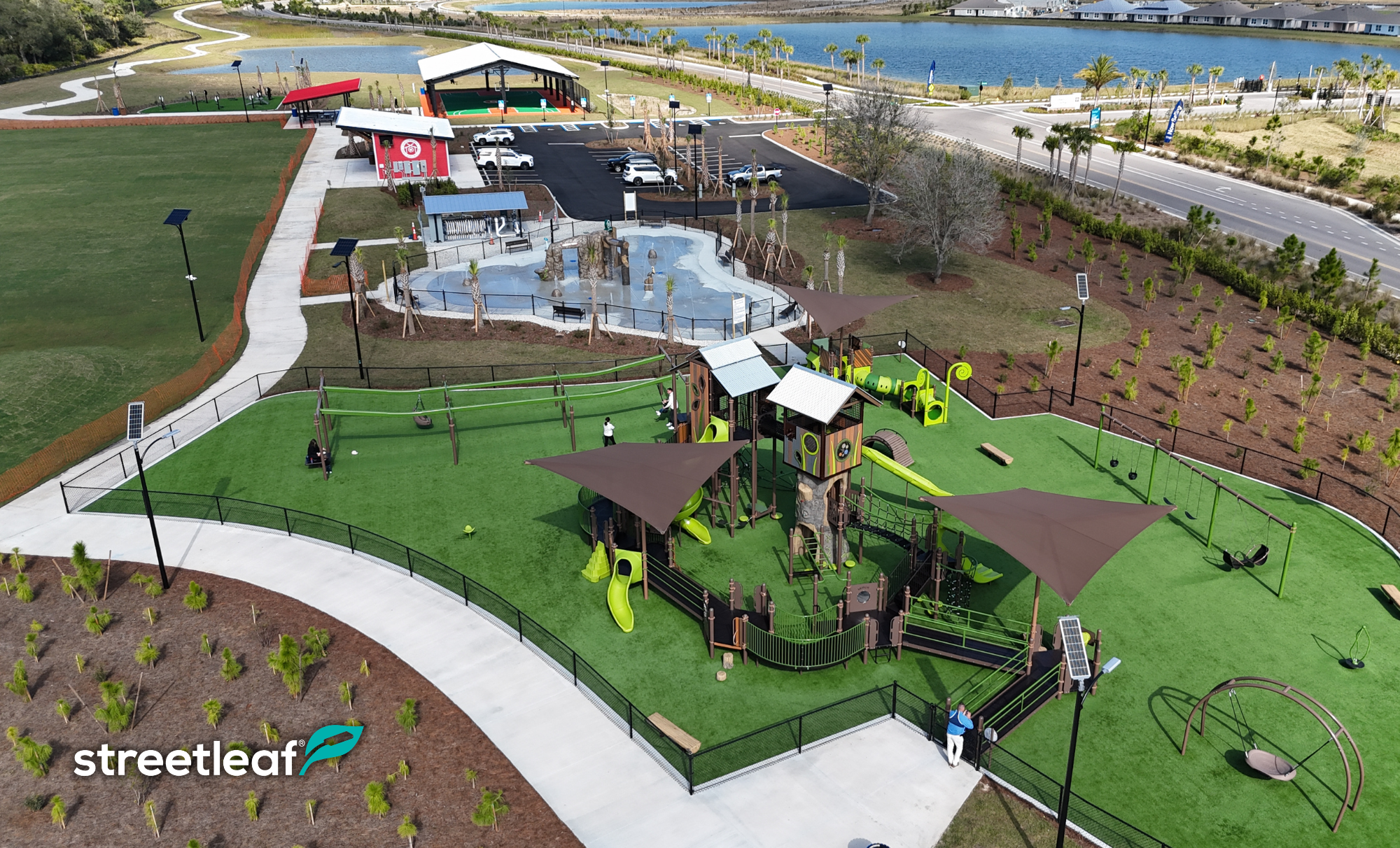
Municipal Solar Streetlights Future City Infrastructure Deployment

3. Microgrid Resilience & Climate Adaptation

With utility grids facing increasing strain from extreme weather and surging power demands, centralized lighting networks are becoming a operational vulnerability. Municipalities are recognizing that off-grid solar streetlights serve as vital resilience infrastructure. During natural disasters or grid blackouts, solar streetlights remain fully operational, ensuring emergency access routes, public spaces, and residential neighborhoods remain safely illuminated.

4. Accelerated ESG Carbon Offsets & LEED v5 Rating Integration

Commercial building standards such as LEED (Leadership in Energy and Environmental Design) and WELL Building Standard are continuously tightening carbon offset requirements. Installing 100% off-grid eco-friendly outdoor lighting provides direct, quantifiable carbon reduction metrics. Replacing 100 legacy grid streetlights with high-efficiency solar units eliminates dozens of metric tons of CO2 emissions annually, helping corporate developers achieve Net-Zero targets.

Economic Comparison: Total Cost of Ownership (TCO) & LCOL

A comprehensive financial analysis demonstrates that off-grid solar streetlighting offers lower Total Cost of Ownership compared to traditional grid-tied LED installations. Below is an engineering estimate based on a standard 1-mile road installation requiring 50 lighting fixtures:

Cost Component Traditional Grid-Tied LED (50 Fixtures) Streetleaf Solar Streetlight (50 Fixtures) Cost Variance / Savings
Civil Trenching & Conduit (1 Mile) $210,000 ($40/linear ft avg) $0 (No Trenching Needed) -$210,000 (100% Savings)
Copper Cabling & Transformer Hookup $45,000 $0 (No Copper Cabling) -$45,000 (100% Savings)
Utility Permit & Connection Fees $15,000 $0 (Zero Grid Interconnection) -$15,000 (100% Savings)
Hardware & Pole Equipment $65,000 $95,000 (Includes Solar/Batteries) +$30,000
Installation & Commissioning Labor $40,000 (Heavy Machinery Required) $12,000 (Fast Single-Pole Install) -$28,000
10-Year Utility Electricity Expenses $68,000 (Based on $0.15/kWh avg) $0 (100% Free Solar Energy) -$68,000 (100% Savings)
Total 10-Year Project Expenditure $443,000 $107,000 SAVINGS: $336,000 (75.8%)

Streamline your capital project budget with off-grid infrastructure.

Inquire Now

Why Enterprise Developers & Municipalities Partner with Streetleaf

Streetleaf is a recognized pioneer in commercial off-grid outdoor lighting. Our leadership in sustainable infrastructure is backed by real-world field performance, rigorous engineering standards, and unmatched service models.

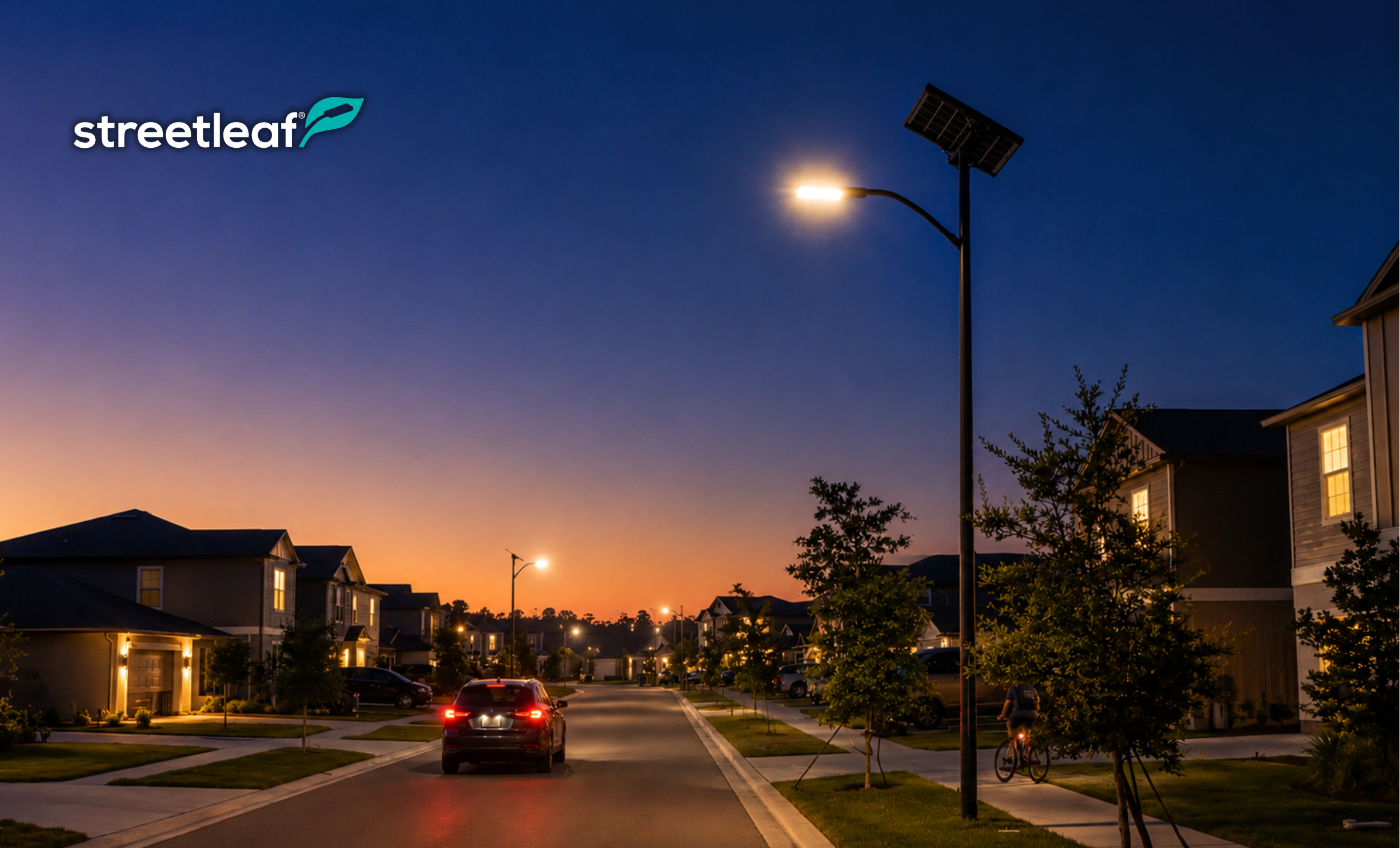
Streetleaf Solar Streetlights Installed in a Safe Residential Neighborhood

Proven Track Record: 1,269+ Lights Deployed Across North America

Streetleaf has deployed over 1,269 commercial-grade solar streetlights across residential neighborhoods, land development sites, municipal corridors, and utility properties. Our installations are designed to operate reliably in diverse climates—from severe coastal hurricane zones to freezing northern environments.

Category 5 Hurricane Rated & Storm Resilient

Every Streetleaf lighting pole and luminaire assembly is structural-engineer certified to withstand Category 5 hurricane force winds (160+ MPH). When extreme weather knocks out municipal grid power, Streetleaf streetlights keep running, protecting neighborhoods and vital thoroughfares.

5+ Days Autonomous Battery Backup

System downtime is unacceptable for safety-critical illumination. Streetleaf systems feature conservative battery autonomy ratios, providing over 5 full nights of continuous light output under conditions of total cloud cover, heavy rain, or severe winter storms.

The Exclusive $0 Upfront Service Agreement Model

Streetleaf eliminates financial barriers to sustainable infrastructure. Through our innovative Lighting Service Agreement, developers, HOAs, and municipalities can install complete solar lighting networks with $0 upfront equipment cost. We handle complete installation, proactive IoT remote monitoring, and long-term maintenance for one predictable, affordable monthly service fee.

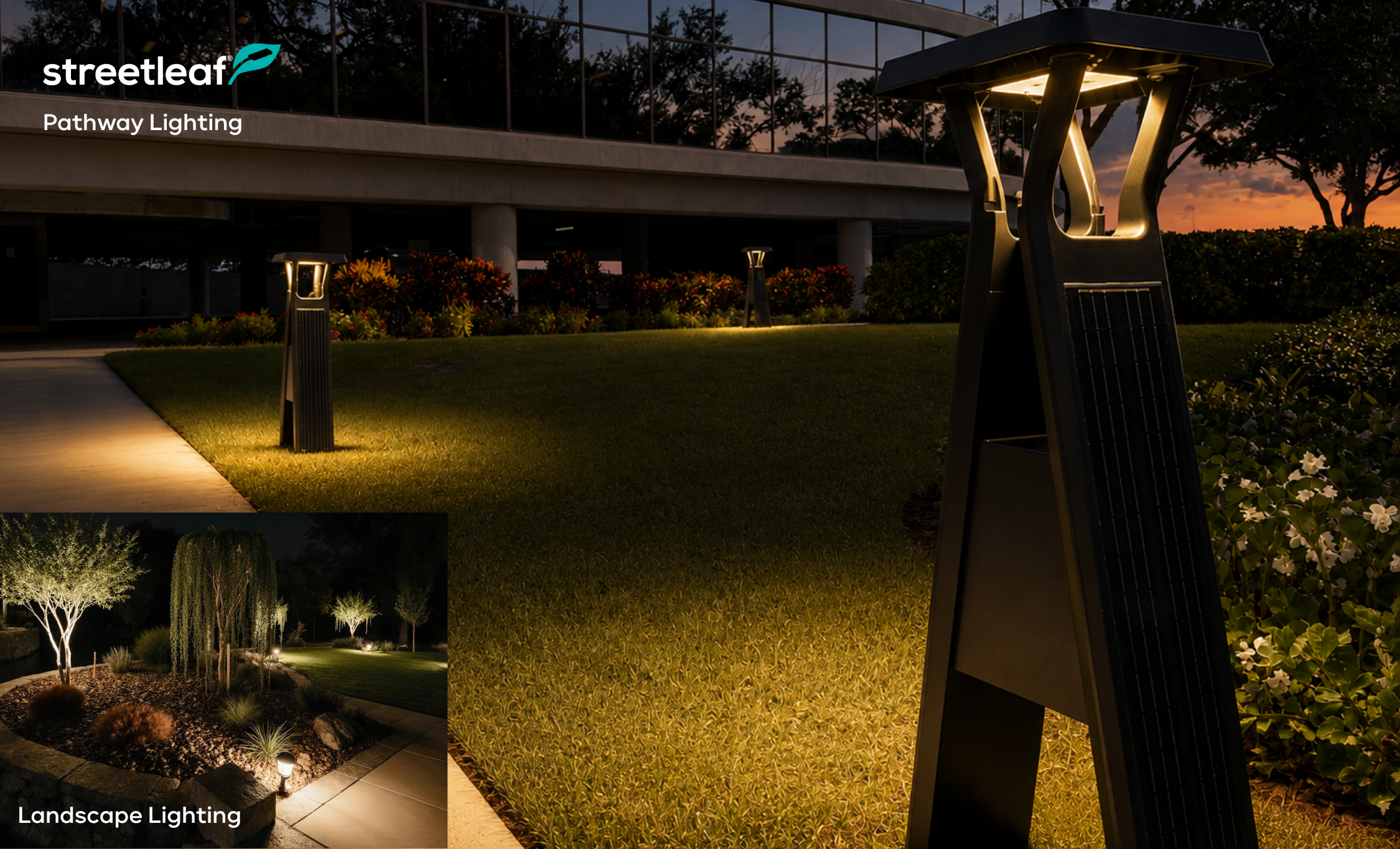
Pathway vs Landscape Eco-Friendly Outdoor Lighting Technology

Frequently Asked Questions (FAQ) – Commercial & Municipal Buyer Guide

Below are technical responses to common questions submitted by real estate developers, municipal procurement officers, and engineering consultants searching for eco-friendly outdoor lighting solutions.

Q1: How do eco-friendly solar streetlights maintain performance during 5 consecutive overcast or rainy days? +

Streetleaf commercial solar streetlights are engineered with a minimum 5-day battery autonomy reserve. This is accomplished by combining high-efficiency monocrystalline bifacial PV panels (which collect indirect light even on overcast days) with high-capacity Grade-A Lithium Iron Phosphate (LiFePO4) energy storage and MPPT intelligent charge control. Additionally, dynamic dimming algorithms automatically adjust power output during extended storm cycles to preserve essential lighting through long periods of cloudy weather.

Q2: What is the true break-even financial timeline compared to traditional grid-tied LED streetlights? +

For new developments or road projects, off-grid solar streetlights deliver an immediate net savings on Day 1 because they eliminate costly underground trenching, copper conduit running, utility transformer fees, and electrical permitting—which typically cost $40 to $80 per linear foot. When factoring in zero ongoing electricity utility charges, the direct capital ROI is realized instantly at installation. Under our $0 Upfront Service Agreement, projects achieve immediate positive cash flow without capital outlay.

Q3: How do bifacial solar panels improve performance compared to standard solar lights? +

Bifacial solar panels feature dual-glass architecture with photovoltaic cells on both the front and rear faces. While the front face captures direct sun rays, the rear face captures ground-reflected ambient light (albedo). On light concrete, asphalt, or snow, this ground-reflected light adds up to 25%–30% total energy harvesting yield, accelerating battery recharge cycles even in sub-optimal solar orientations.

Q4: Are Streetleaf solar streetlights certified for high-wind coastal regions and hurricane zones? +

Yes. Streetleaf solar streetlight assemblies are structurally engineered and FEA-tested to withstand Category 5 hurricane wind loads exceeding 160 MPH (257 km/h). Luminaires and mounting hardware are constructed from heavy-gauge marine-grade aluminum alloys with corrosion-resistant powder coating, making them ideal for coastal and high-humidity environments.

Q5: What is Dark-Sky compliance and why is it mandatory for modern municipal developments? +

Dark-Sky compliance ensures that outdoor luminaires direct 100% of emitted light downward onto target ground surfaces with zero light escaping into the upper atmosphere (U0 rating). This prevents artificial skyglow, eliminates glare for drivers, respects residential sleep health, and protects wildlife migration. Many municipalities and HOAs now require International Dark-Sky Association (IDA) compliance for all new outdoor lighting permits.

Q6: What maintenance is required over a 10-year operational lifespan? +

Streetleaf systems require virtually zero routine maintenance. Our LiFePO4 batteries are rated for over 4,000 cycles (>10 years of daily operation), and our solid-state LED luminaires carry a 100,000-hour L70 lifespan rating. Vertical or steeply angled solar panel orientations minimize dust and snow accumulation naturally via rain rinsing. Under our Service Agreement, Streetleaf handles all remote monitoring and proactive component servicing automatically.

Q7: How does the $0 Upfront Service Agreement work for HOAs, land developers, and cities? +

Under the Streetleaf Service Agreement, we supply, install, monitor, and maintain the entire off-grid solar streetlight infrastructure with zero upfront equipment or capital cost. The property owner or municipality simply pays a low, fixed monthly service fee that covers complete operational hardware, 24/7 cloud telemetry monitoring, and all ongoing maintenance—eliminating capital constraints and operational risk.

Q8: Can Streetleaf solar streetlights be integrated with motion sensors and smart city IoT networks? +

Yes. Every Streetleaf luminaire can be equipped with high-precision microwave/PIR motion sensors for dynamic dimming profiles (e.g., maintaining 30% baseline illumination until motion activates 100% output). Integrated cellular IoT modules allow facility managers to monitor battery health, power generation, and light status remotely from a centralized cloud dashboard.

Partner With Streetleaf

Ready to Upgrade to Resilient Eco-Friendly Outdoor Lighting?

Join over 1,269+ successful deployments across North America. Get a customized photometric design, engineering feasibility assessment, or explore our $0 Upfront Service Agreement option today.

Inquire Now Request Virtual Demo