
High-efficiency, 100% off-grid solar streetlights designed to meet DOT standards, withstand Category 5 hurricanes, and eliminate grid-trenching utility overhead across American cities.
Across the United States, municipal public works departments, Department of Transportation (DOT) authorities, utilities, and commercial land developers are rapidly shifting from legacy utility-grid infrastructure toward autonomous, high-efficiency municipal solar lighting systems. Driven by volatile utility electricity pricing, escalating copper cable theft, grid instability during severe weather events, and stringent municipal carbon-neutrality mandates, off-grid solar illumination has transitioned from an alternative niche to standard public infrastructure policy.
Deploying municipal solar streetlights allows U.S. cities to eliminate the single largest capital expenditure in outdoor lighting projects: underground trenching, conduit laying, and utility grid interconnections. Utility-connected street lighting often incurs cabling costs ranging from $50 to $150 per linear foot. Off-grid solar solutions completely bypass grid dependencies, enabling immediate installation on arterial roadways, rural highways, public parks, residential HOAs, and municipal parking facilities.
This industry whitepaper evaluates the engineering frameworks, manufacturing paradigms, and technological benchmarks of the top factories and global exporters manufacturing commercial-grade solar streetlights for the U.S. market.
Surpassing U.S. Department of Transportation standards requires precision engineering across photovoltaic conversion, energy storage, optical control, and mechanical durability.
Utilizing N-Type TOPCon bifacial glass-glass solar panels capturing both direct overhead sunlight and ground-reflected albedo light, increasing total daily energy yields by 15% to 25% even during overcast winter days.
Engineered with 6063-T6 marine-grade aluminum extrusions and structural FEA analysis to withstand wind velocities up to 160 MPH, fully compliant with AASHTO and ASCE 7-16 structural requirements for coastal U.S. regions.
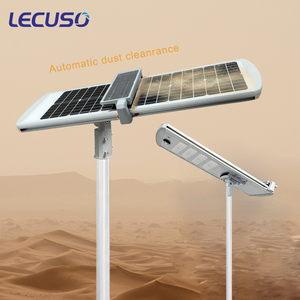
Integrated robotics clean dust, pollen, bird droppings, and industrial particulate off the solar glass panel twice daily, preserving 98.5% solar absorption efficiency in dusty agricultural and desert regions.
High-density Lithium Iron Phosphate (LiFePO4) battery cells managed by intelligent BMS with thermal balancing, providing over 4,000 deep discharge cycles (10+ year service life) and continuous 5-day operation during severe weather.
Standardized NEMA 7-pin or Zhaga Book 18 receptacles supporting mesh gateways (LoRaWAN, NB-IoT, Zigbee) for centralized municipal control, cloud energy telemetry, scheduled dimming, and automated repair ticketing.
Batwing IESNA Type II, III, and IV optics with zero uplight (U0 rating) preventing skyglow. Includes 590nm narrow-spectrum wildlife-friendly amber LED modes for coastal sea turtle nesting compliance.
When municipal procurement committees evaluate foreign factories and exporters serving North America, selecting the correct structural topology (All-in-One, All-in-Two, or Split Systems) is essential to match regional solar irradiance, latitude tilt requirements, and maintenance operations.
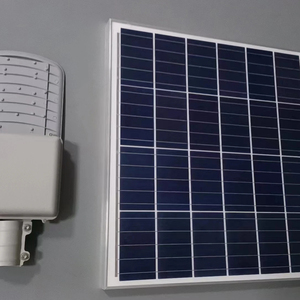
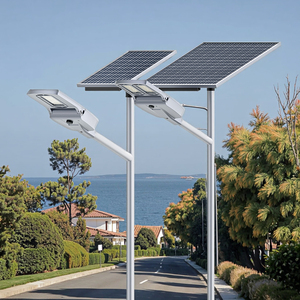
All-in-Two configurations separate the luminaire head (containing the LED engine, MPPT controller, and LiFePO4 battery pack) from the solar panel module. This architecture allows the solar panel to be rotated 360 degrees and tilted independently to optimize solar azimuth angles across northern U.S. states (such as Washington, Minnesota, and Maine) while directing the optical beam precisely onto the roadway pavement.
Designed specifically for DOT collector roads and commercial industrial parks, these systems feature integrated hot-dip galvanized steel poles (ASTM A123 standard) with internal battery compartments. Internalizing the battery within the pole structure protects power cells from extreme ambient temperatures and vandalism while maintaining a sleek, modern architectural aesthetic.
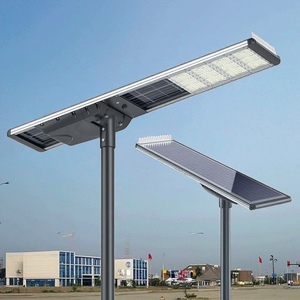
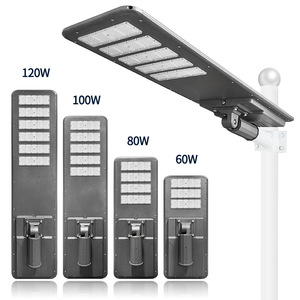
Utilizing high-lumen SMD 5050 LED chips yielding up to 210 lm/W, these integrated systems are tailored for high-speed multi-lane arterial roads. Advanced MPPT (Maximum Power Point Tracking) algorithms adjust charging rates in microsecond intervals, ensuring conversion efficiency exceeds 99% even under rapid cloud coverage shifts.
In extreme thermal environments such as the Mojave Desert (Nevada, Arizona) or Southern Texas, split-type systems house the battery pack underground in IP68 insulated battery boxes or at the base of the pole. This subterranean isolation ensures battery temperatures remain within optimal operating thresholds (15°C to 25°C), doubling chemical battery longevity.
Deployment conditions vary drastically across North America. Top municipal solar streetlight factories engineer custom regional configurations to guarantee year-round operational continuity.
Regions: Florida, Gulf Coast, Carolinas.
Engineering Focus: Category 5 wind load compliance (160+ MPH), C5-M anti-corrosion marine powder coating, stainless steel 316 fasteners, IP67 sealed battery enclosures.
Regions: Minnesota, Wisconsin, Alaska, Michigan.
Engineering Focus: Self-heating LiFePO4 battery BMS, steep 60° solar tilt angles for snow shedding, ultra-low ambient temperature operating tolerance (-40°C to +60°C).
Regions: Arizona, Nevada, Inland California.
Engineering Focus: Underground subterranean battery placement, passive heat sink thermal dissipation, UV-stabilized polycarbonate optical lenses resisting yellowing.
Regions: Flagstaff AZ, Coastal California, Wildlife Refuges.
Engineering Focus: Dark-Sky Association (IDA) certified zero-uplight (U0), 2700K-3000K warm CCT, integrated microwave radar sensor dimming.
Financial analysis for U.S. municipal public works directors demonstrates that off-grid solar streetlights yield a positive Return on Investment (ROI) within 24 to 36 months of installation, primarily by eliminating trenching, copper wire installation, transformer upgrades, and ongoing monthly utility electric bills.
| Evaluation Parameter | Traditional Utility Grid LED Lighting | Off-Grid Municipal Solar Lighting |
|---|---|---|
| Trenching & Conduit Cost | $50 - $150 per linear foot (High Cost) | $0 (Zero Trenching Required) |
| Utility Interconnection Fee | $1,500 - $4,000 per pole point | $0 (Self-Contained Microgrid) |
| Copper Wire Theft Risk | High (Causes municipal blackouts & repairs) | Zero (No copper cable networks) |
| Monthly Electricity Utility Bill | Escalating grid tariffs ($15-$45/pole/mo) | $0.00 (100% Free Solar Energy) |
| Blackout Operationality | Fails during grid outages / storm damage | Stays 100% lit with 5-day battery reserve |
| 10-Year Cumulative Cost (50 Poles) | ~$240,000 (CAPEX + Utility + Maintenance) | ~$85,000 (CAPEX Only - 64% TCO Savings) |
Vetting international original equipment manufacturers (OEM/ODM) requires strict verification of factory testing capabilities, quality assurance protocols, and international regulatory certifications.
Leading exporters operate darkrooms equipped with Integrating Spheres and Type C Distributed Goniophotometers to generate accurate IES files for DIALux photometric street lighting simulations.
In-house testing equipment including Salt Spray Corrosion Chambers (ASTM B117), Thermal Shock Chambers (-40°C to +85°C), Waterproof IPX6/IPX8 Pressure Test Rigs, and Vibration Simulation Tables.
Full compliance certifications including UL 1598 (Luminaires), UL 2271 (Lithium Batteries), FCC Part 15 Class B (EMI/RFI protection), RoHS, CE, and Dark-Sky IDA approval compatibility.
Federal funding under programs such as the Bipartisan Infrastructure Law (BIL) and the Promoting Resilient Operations for Transformative, Efficient, and Cost-saving Transportation (PROTECT) program favors resilient microgrid street lighting. Leading exporters work directly with U.S. municipal distributors to provide complete component documentation, structural steel certification, and final assembly compliance aligned with Buy America (BABA) guidelines.
Under Section 48 and Direct Pay provisions of the Inflation Reduction Act, tax-exempt entities—including U.S. cities, counties, tribal governments, and municipal utilities—can receive direct cash payments covering 30% or more of the capital cost of qualified solar + energy storage municipal microgrid installations.
To overcome initial capital expenditure constraints, leading U.S. municipal exporters partner with turnkey energy service companies (ESCOs) to offer $0 upfront cost service agreements. Municipalities pay a predictable monthly operational fee that covers luminaire hardware, custom engineering, remote IoT performance monitoring, and complete warranty maintenance—guaranteeing immediate net-positive budget savings.
Addressing core technical, structural, and operational inquiries regarding municipal solar street lighting deployment.
Top municipal solar streetlights are engineered with an autonomous battery reserve factor of 5 to 7 days. Coupled with steep solar panel tilt angles (50°-60°) that cause snow to slide off naturally, high-efficiency MPPT controllers, and self-heating LiFePO4 batteries, systems maintain 100% lighting continuity even in Northern U.S. winter storms.
Commercial municipal solar poles and integrated fixtures undergo finite element analysis (FEA) structural testing to meet ASCE 7-16 and AASHTO standards, rated to withstand basic wind speeds of 150 to 180 MPH (equivalent to Category 5 hurricane force winds) with full EPA (Effective Projected Area) safety margins.
Yes. By specifying standard 7-pin ANSI C136.41 NEMA receptacles or Zhaga Book 18 sockets, municipal streetlights seamlessly plug into municipal CMS networks via LoRaWAN, Cellular NB-IoT, or Zigbee wireless nodes, enabling remote dimming schedules, real-time energy tracking, and automated fault alerts.
Commercial-grade Lithium Iron Phosphate (LiFePO4) battery packs managed by smart micro-BMS controllers deliver 4,000+ charge/discharge cycles at 80% Depth of Discharge (DoD). Under standard municipal operating conditions, this equates to a maintenance-free service lifespan of 10 to 12 years.
Because each solar streetlight functions as an independent, self-contained off-grid energy microgrid, there are no underground copper cabling networks connecting the poles. This completely eradicates copper theft—a major cause of multi-block street lighting blackouts in urban U.S. centers.
Absolutely. Exporters provide fixtures certified with zero uplight (U0 rating), full cut-off shielding, warm 2700K-3000K correlated color temperatures, and dedicated 590nm amber LED channels designed to comply with Florida Fish and Wildlife Conservation Commission (FWC) sea turtle protection codes.